- Africa
- Somalia
 Food insecurity

Food insecurity data for anticipatory action: can FEWS NET and the IPC be used interchangeably?
In anticipatory action, two sources of data on food insecurity are prominent: FEWS NET and IPC. Can these be used interchangeably to trigger frameworks? Evidence from Somalia examines the similarities and critical differences between the two.
Food insecurity data for anticipatory action: can FEWS NET and the IPC be used interchangeably?
Food insecurity projections are a central component of many anticipatory action frameworks, particularly those for drought. But while indicators such as wetness indices – for example, the Standardized Precipitation Index (SPI) – can help identify and forecast meteorological drought, they cannot fully capture its impacts on people’s livelihoods. Food insecurity projections therefore provide a valuable proxy for these real-world impacts, helping practitioners anticipate crises and inform trigger systems.
In anticipatory action, two food insecurity systems are especially prominent: the Famine Early Warning Systems Network (FEWS NET) and the Integrated Food Security Phase Classification (IPC). Both provide regular assessments and projections using the same five-phase classification scale, from ‘Minimal’ (Phase 1) to ‘Famine’ (Phase 5). Despite this shared classification, they differ in their methodologies, publication schedules and analytical approaches (Figure 1).
Figure 1
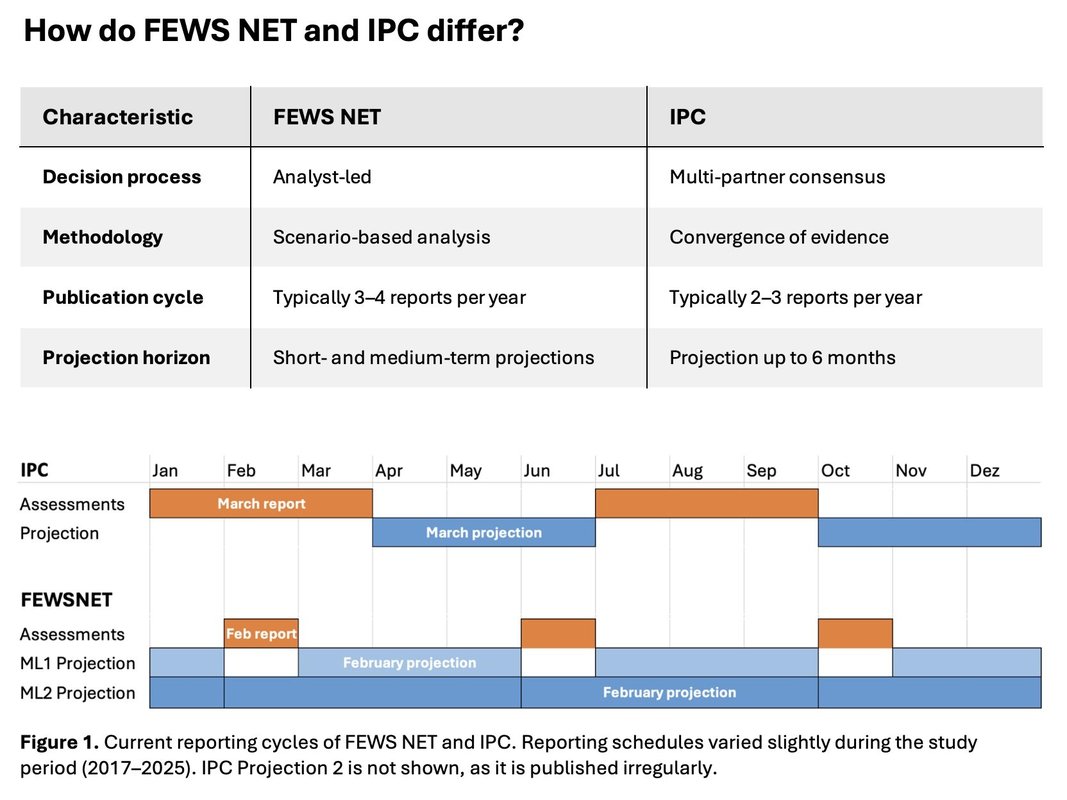
Figure 1. Methodologies, publication schedules and analytical approaches of FEWS NET and IPC.
Somalia has experienced repeated and severe droughts over recent decades and continues to face high levels of food insecurity. To anticipate and mitigate these impacts, the Somali Red Crescent Society, supported by the German Red Cross, the Red Cross Red Crescent Climate Centre and the Heidelberg Institute for Geoinformation Technology (HeiGIT), developed an early action protocol (EAP) for drought. Its trigger system combines FEWS NET food insecurity projections with the SPI-12 wetness index, ensuring it is activated when a drought is expected to have humanitarian impacts, rather than reflecting meteorological conditions alone.
The EAP was triggered in January 2025, just as an unexpected freeze on USAID funding temporarily shut down FEWS NET operations. This cut off a critical data stream and organizations that relied on FEWS NET, including the partners involved with the EAP, suddenly had to consider whether IPC data could serve as a suitable substitute. The urgent situation highlighted both the vulnerability of critical humanitarian data streams and the practical challenges of rapidly evaluating alternative data sources.
HeiGIT’s other work on anticipatory action had shown that selecting an appropriate dataset for food insecurity is a recurring challenge for practitioners. Questions about the differences between FEWS NET and IPC, and whether the two systems can be used interchangeably, arise frequently. Together, these challenges raised the question: can FEWS NET and IPC be used interchangeably in anticipatory action frameworks?
To explore this, HeiGIT conducted a comparative analysis of food insecurity data for Somalia from FEWS NET and IPC, focusing on two questions:
- How similar are FEWS NET and IPC assessments and projections across space and time?
- How do the two systems compare in terms of forecasting skill and projection bias?
We answered these by comparing historical assessments and projections, then evaluating the forecasting skill of both systems against subsequent food insecurity assessments.
What did we find?
Comparing FEWS NET and IPC food insecurity data for Somalia between 2017 and 2025 revealed broad agreement, but also important differences for operational anticipatory action. Across the study period, both systems showed similar temporal patterns in their current assessments and projections. Average current assessments were almost identical, while FEWS NET projections were, on average, slightly more severe than those of the IPC (Figure 2).
Figure 2
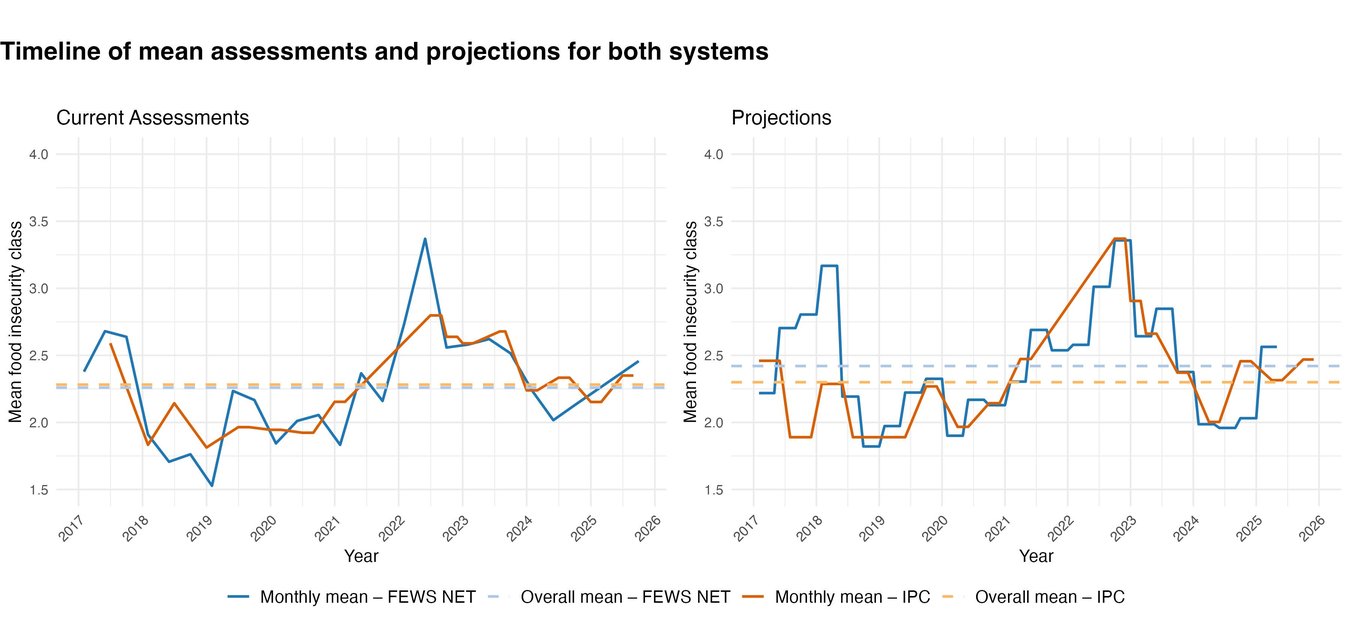
Figure 2. Timeline of mean current assessments and projections of food insecurity for both systems. Mean values are calculated across all districts of Somalia. The overall mean across all districts and the full study period is indicated by the light-coloured dashed lines.
The largest differences emerged for the highest food insecurity classes (‘Emergency’ and ‘Famine’; IPC Phases 4 and 5). FEWS NET projected these conditions considerably more often than the IPC across many parts of Somalia. In some districts, particularly in Somaliland and central Somalia, the share of months projected to have Phase 4 or 5 differed by more than 10 percentage points. These differences are particularly relevant because these higher classes are commonly used to trigger anticipatory action (Figure 3).
Figure 3
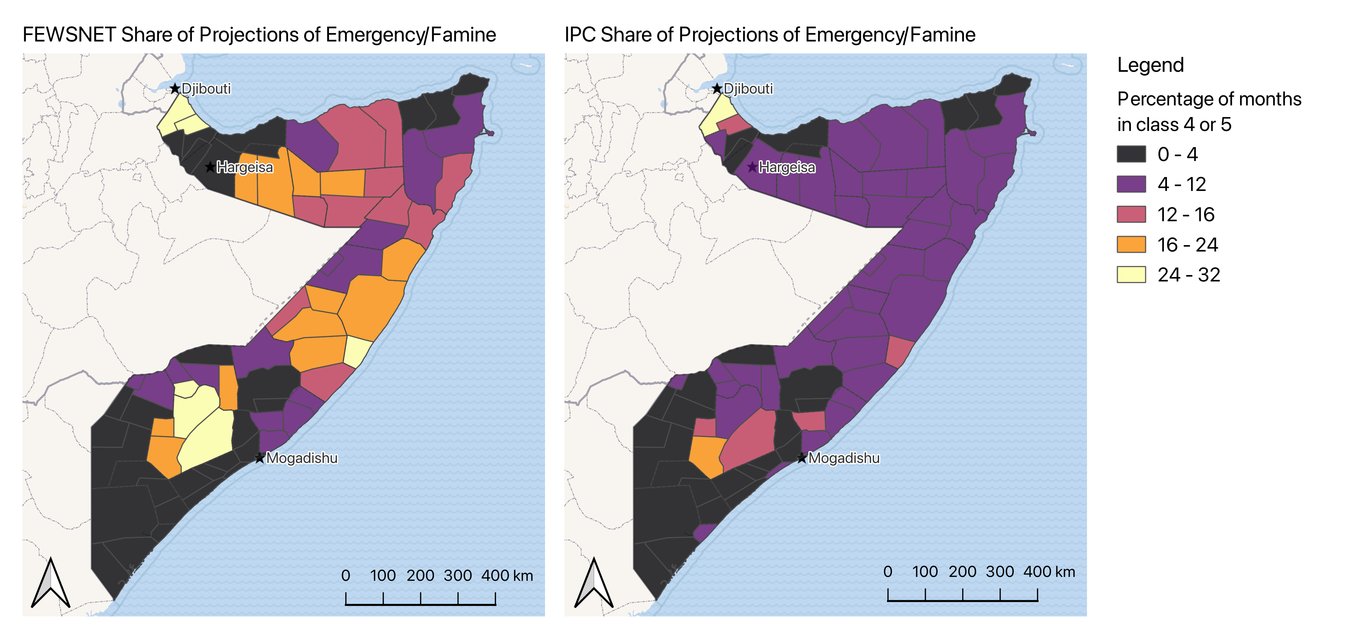
Figure 3. Spatial distribution of the percentage of months projected in ‘Emergency’ or ‘Famine’ conditions (IPC classes 4 or 5) across Somalia from 2017-2025. Percentages represent the share of all projected months in which a district was classified as class 4 or 5.
We also evaluated how well projections matched subsequent food insecurity assessments. Both systems showed a similar, moderate level of forecasting skill, with exact agreement in around two-thirds of cases: approximately 62 per cent for FEWS NET and 65 per cent for IPC. Importantly, more than 90 per cent of incorrect projections differed by only one food insecurity class.
One of the most interesting findings was that both systems showed the same overall forecasting pattern. When projecting lower food insecurity classes, they were more likely to underestimate how severe conditions would become. For higher food insecurity classes, the opposite was true: projections tended to overestimate subsequent conditions. This was particularly evident for ‘Emergency’ (Phase 4), where projections were even more often followed by a less severe assessment than by another Phase 4. Although these mismatches became more frequent during major droughts, they were usually small, differing by only one food insecurity class (Figure 4).
Figure 4
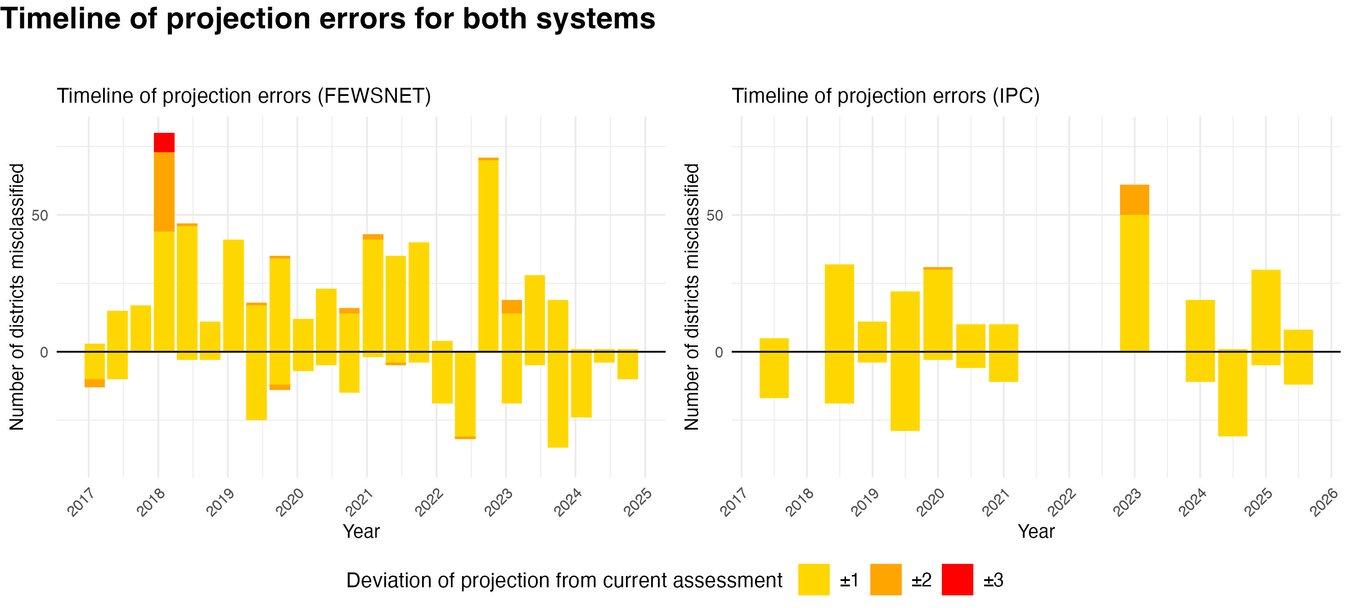
Figure 4. Timeline of projection errors, showing the number of districts with mismatches between projected and subsequent current food insecurity classification for each reporting period. Positive values indicate overestimation of food insecurity (projected class higher than observed), while negative values indicate underestimation.
What does this mean for practitioners?
Our results show that FEWS NET and IPC are broadly consistent, but not directly interchangeable. This does not mean that one system is more accurate or ‘better’ than the other; given their different methodologies and reporting schedules, some divergence is expected.
However, these differences can directly affect trigger behaviour. Because FEWS NET projected ‘Emergency’ and ‘Famine’ conditions more frequently in many parts of Somalia, a trigger calibrated using FEWS NET may activate earlier or more often than one based on IPC. Simply replacing one dataset with the other could therefore result in fewer trigger activations and, potentially, delaying anticipatory actions. Any switch between datasets should be accompanied by careful testing and trigger recalibration.
From an anticipatory action perspective, overestimating food insecurity (i.e., higher classes) may be preferable to systematically underestimating crises, which could delay or prevent early action. However, this precautionary tendency may also increase trigger activations below the targeted impact. Understanding this trade-off is therefore important, particularly where resources for anticipatory action are limited.
These findings should, however, be interpreted with caution. Our analysis is limited by differences in reporting schedules, the absence of a true ground truth for evaluating projections, and its sole focus on Somalia between 2017 and 2025. While the current assessments provide a solid benchmark, the observed patterns should not be assumed to apply directly to other countries or operational contexts.
Within these limitations, our findings suggest that FEWS NET and IPC should not be considered directly interchangeable for operational anticipatory actions to address food insecurity in Somalia. If organizations need to switch between datasets, they should carefully assess the implications for trigger behaviour before implementing changes in operational systems.
Do you want to dive into this topic and the data more deeply, or discuss how this impacts your frameworks? Read our full paper for a detailed breakdown of the methodology or reach out directly to our team. We are happy to connect and hear about your experiences.
This article is based on a collaboration between the German Red Cross, HeiGIT and the Somali Red Crescent Society. Written by Anne Schauss, Karen Dall and Ferdinand Seyffer, with inputs from Richard Muchena.

 Drought / dry spell
 Conflict