- Africa
- Eswatini
 Drought / dry spell

The Baphalali Eswatini Red Cross Society acts to anticipate the impacts of a coming drought
With the impacts of El Niño drawing ever closer across southern Africa, the Baphalali Eswatini Red Cross Society activated its early action protocol for drought after forecasts predicted below-normal rainfall from October to December.
The Baphalali Eswatini Red Cross Society acts to anticipate the impacts of a coming drought
With the impacts of El Niño drawing ever closer, countries across southern Africa are acting now to support those most at risk from the drought that is forecast to strike the region. One country at risk is Eswatini and, on 9 September 2026, the Baphalali Eswatini Red Cross Society (BERCS) activated its early action protocol (EAP) for drought after forecasts predicted below-normal rainfall from October to December.
This activation saw the disbursement of 452,492 Swiss francs (approx. 548,700 US dollars/481,000 euros) from the IFRC's Disaster Response Emergency Fund. These funds will be used to implement anticipatory actions that will protect the most vulnerable households ahead of the drought, through measures including cash assistance for food, livelihood and livestock support, and the provision of clean water. The funds will also help to strengthen community engagement, monitoring activities and BERCS’s operational capacity.
The actions, which are being carried out in close coordination with the National Anticipatory Action Working Group, will focus on the Lubombo and Shiselweni regions, where the drought is expected to worsen food insecurity and exacerbate water shortages. The worst impacts are expected to occur during the January–March lean season; by acting now, the BERCS aims to ensure people are better able to cope during the challenges to come.
This activation in Eswatini follows those in other countries, including Lesotho and Zimbabwe, which are also facing severe droughts. With the looming drought forecast to peak in January 2027, acting now – during the lead time for this hazard – will protect livelihoods, save lives and increase communities’ preparedness.
Thanks to Catalina Torres and Tawonga Dalikeni, IFRC, and Sebensile Tsele and Siphelele Mkhonta, BERCS, for their inputs.
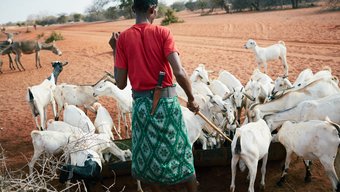
Photo: Luuk de Vocht/IFRC (nb this was taken during a drought in 2024).