
Anticipatory action in Haiti

Haiti, a small country on the western half of the island of Hispaniola, faces numerous challenges. Alongside longstanding insecurity, violence and poverty, it is one of the most vulnerable countries to natural hazards, including hurricanes, tropical storms, floods and drought. Haiti also grapples with climate-related threats such as rising sea levels, increasing temperatures and prolonged heat waves. Rainfall patterns are seeing more extreme events, which cause massive floods and deadly landslides, alongside an overall long-term decline in the quantity of rain. Climate models project that these hazards will become more frequent and/or severe in the coming years.

Haiti's location and geography play a role in its hazard profile. It lies within the Atlantic hurricane belt and its low-lying coastal plain amplifies its vulnerability to sea level rise. As a mountainous nation, it is vulnerable to landslides. It is also at risk from earthquakes, with the event in 2010 being catastrophic. Related to its deep-rooted vulnerability and hazard exposure, Haiti is particularly vulnerable to disease outbreaks and epidemics.

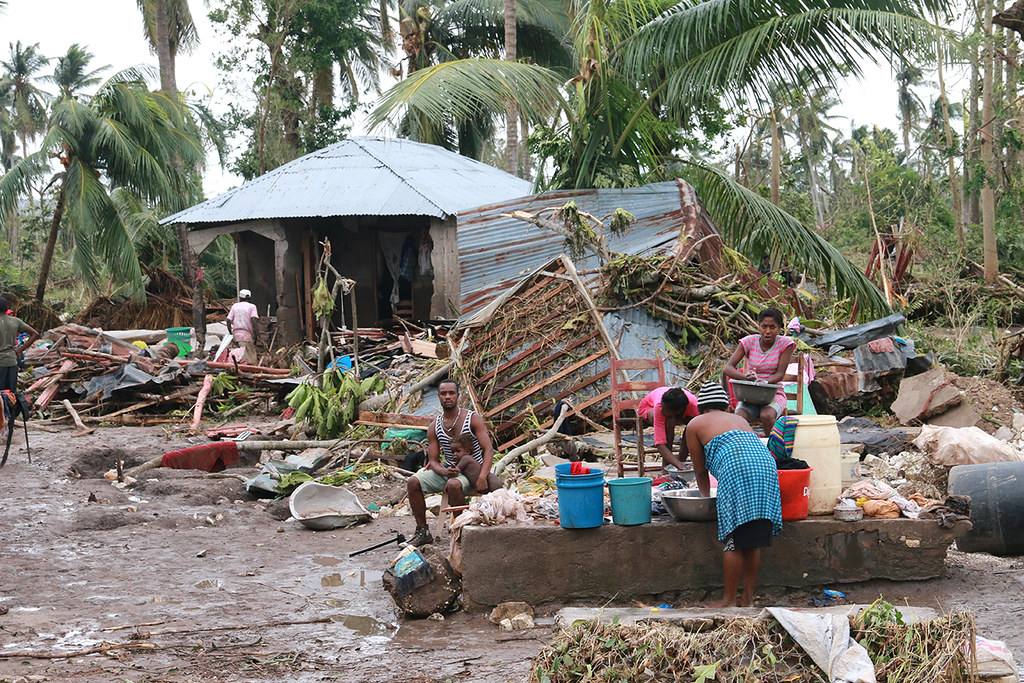
Over 96 per cent of its population is exposed to these hazards, which disrupt livelihoods, exacerbate food insecurity and heighten the country’s fragility and conflict. In the last three decades, Haiti has experienced 34 flooding events, 35 significant storms and 31 hurricanes, including the devastating Hurricane Matthew in 2016. Periodic droughts severely affect agricultural production and deepens the country’s food insecurity, which reached record levels during the political crisis that escalated in early 2024.

These frequent and extreme weather events and natural hazards increase the risk of conflict and hinder Haiti’s long-term development and ability to recover from repeated crises. Together, these compounding crises underscore the need for anticipatory action in the country to mitigate the humanitarian impacts of these multiple threats and bolster the resilience of its population.

INFORM RISK INDEX (2025)    

Hazard and exposure: 7.7  |  Vulnerability: 6.7  |  Lack of coping capacity: 7.2 |  Total: 7.2 (very high)  |  Rank: 11

HAZARDS COVERED BY ANTICIPATION    

Cyclones | Epidemic (Covid-19) | Floods

NUMBER OF PEOPLE REACHED BY ANTICIPATORY ACTION (ACTIVATIONS)

  • Activation for floods by WFP and the government, 2023: 18,775
    • More information about this activation is available in English and French.

ANTICIPATORY ACTION PARTNERS IN THE COUNTRY

National Hydrometeorological Service (Unité Hydro-Météorologique d’Haïti) | Directorate-General of Civil Protection (Direction Générale de la Protection Civile) | Ministry of Social Affairs and Labour (Ministère des Affaires Sociales et du Travail) | OCHA | WFP | UNICEF | IOM | Diakonie Katastrophenhilfe | Humanite & Inclusion | Catholic Relief Service

EXPERIENCE WITH ANTICIPATORY ACTION 

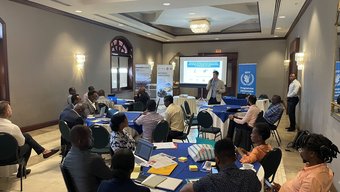
  • WFP is developing anticipatory action through a pilot forecast-based financing (FbF) initiative. In 2021, WFP contributed to an improved national early-warning system and helped strengthen the capacities of local disaster risk management structures through training workshops. Throughout 2022, it plans to explore the possibilities of connecting elements of ASPIRE, Haiti’s adaptive safety net, with anticipatory actions and disaster preparedness to enhance institutional support provided to people affected by future disasters.
  • In April 2020, FAO began early actions ahead of the continued spread of the Coronavirus pandemic. It distributed vegetable seeds, cash, and hygiene kits to households whose food security was expected to further deteriorate due to the secondary impacts of Covid-19.

Further information