- Americas
- Venezuela
 El Niño / La Niña
El Niño 2026: a closing window for anticipatory action in Latin America and the Caribbean
The Technical Working Group on Anticipatory Action in Latin America and the Caribbean has published a new briefing on El Niño and anticipatory action in the region. Its message to governments, humanitarian actors and donors is direct: the capacities to act early are in place, but the window to use them is measured in weeks, not months.
El Niño 2026: a closing window for anticipatory action in Latin America and the Caribbean
The Technical Working Group on Anticipatory Action in Latin America and the Caribbean (GTAA LAC) has published a new advocacy briefing on El Niño and anticipatory action in the region. Its message to governments, humanitarian actors and donors is direct: the capacities to act early are in place, but the window to use them is measured in weeks, not months.
La Niña ended in early 2026 and the equatorial Pacific is currently El Niño/Southern Oscillation-neutral (ENSO), but subsurface ocean temperatures have risen for six consecutive months, a physical signal that supports a transition to El Niño. The National Oceanic and Atmospheric Administration's Climate Prediction Center now gives an 82 per cent probability of El Niño for May to July 2026, rising to 96 per cent by December 2026 to February 2027, and the International Research Institute for Climate and Society reaches similar figures. Between October and February, a two-in-three chance of a strong or very strong event is forecast.
The forecast does not arrive alone. Since February 2026, the conflict in the Strait of Hormuz has disrupted around one third of global maritime fertilizer trade, and the Food and Agriculture Organization of the United Nations expects fertilizer prices to be 15 to 20 per cent above pre-crisis levels in the first half of the year, leaving smallholder farmers to face adverse climate conditions and reduced access to fertilizers at the same time. The World Food Programme (WFP) estimates that 2.2 million additional people could face acute hunger in the region if the conflict persists beyond June, and the GTAA LAC’s briefing argues that the response should be sized for this compound scenario, not the climate risk alone.
The projected impacts fall hardest on populations already facing food insecurity: drought in the Central American Dry Corridor, along the Colombian and Venezuelan Caribbean, and across the Andean altiplano; and flooding on the coast of Ecuador and northern Peru. Each subregion has its own window for preparedness and several of them are open now.
The region is already acting. As of March 2026, there are active or developing anticipatory action frameworks in 22 countries, with 37.8 million US dollars in pre-arranged financing. In March, activations coordinated by the UN Office for the Coordination of Humanitarian Affairs and funded by the Central Emergency Response Fund, mobilized 10.5 million US dollars to protect up to 145,000 people across El Salvador, Guatemala and Honduras before the peak of the drought; this was complemented by WFP activations in Belize and Nicaragua, and by Red Cross early action protocols. Meanwhile frameworks are active or in development in Bolivia, Colombia, Ecuador, Peru and Venezuela.
The technical capacity is present; what is missing is financing at the scale that a moderate-to-strong El Niño event would require. This in turn needs timely financing and political will. In Central America, the March activations already protected people during parts of the Primera season; securing a second activation for the Postrera season now depends on financing being committed ahead of the July-to-September window; in the Colombian and Venezuelan Caribbean and the Andean altiplano, preparations for the second half of the year must begin now.
The briefing calls on:
- governments to integrate the updated ENSO forecast into national and subnational contingency planning
- humanitarian actors to scale up activations and finalize protocols for drought and flooding
- donors to commit flexible financing before El Niño is officially declared, building on the investments already made in early warning systems and existing frameworks, rather than starting from scratch – and not only for this El Niño, but for the ENSO cycles that will follow.
The full briefing, El Niño 2026: Anticipatory Action in Latin America and the Caribbean, is available in English and Spanish, with the detailed forecast, the subregional impact table and the full set of recommendations, available to download below.
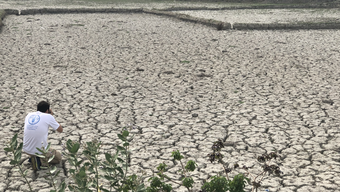
Photo: Irrigation of food crops during the dry season in drought-affected Nicaragua, made possible by the use of special reservoirs to capture and store excess rainwater during the country's rainy season. © 2011CIAT/NeilPalmer
 Drought / dry spell