
- Africa
- Kenya
 Flash flood

WAHAFA partners activate two anticipatory action plans in Kenya ahead of floods
With seasonal rainfall forecasts indicating increased flood risks, two anticipatory action plans were activated in Kenya, enabling readiness actions to take place in Isiolo, Samburu and Turkana counties.
WAHAFA partners activate two anticipatory action plans in Kenya ahead of floods
With seasonal rainfall forecasts indicating increased flood risks, two anticipatory action plans (AAPs) for flooding were activated in Kenya during September and October 2026. Combined, the two activations received more than 120,000 euros in anticipatory financing, enabling readiness actions to take place in Isiolo, Samburu and Turkana counties.
These activations took place under the Welthungerhilfe (WHH) Anticipatory Humanitarian Action Facility (WAHAFA). As Phase 1 activations, they sought to strengthen communities’ readiness to act ahead of floods through early warnings and measures to prepare communities to receive cash assistance, should further phases of the AAP be activated.
What is WAHAFA?
WAHAFA, co-funded by the German Federal Foreign Office, works with international non-governmental partners and their local partner organizations. When the predefined triggers in AAPs – which are developed together with communities and validated under WAHAFA – are reached, local partners implement the planned anticipatory actions.
Preparing for riverine and flash floods in Isiolo and Samburu
In Isiolo and Samburu, WHH Kenya and the Pastoralist Community Initiative Development and Assistance (PACIDA) activated Phase I of their AAP for riverine and flash flooding, releasing 83,740 euros. This was triggered after the forecast for the October–November–December season, issued by the Kenya Meteorological Services Authority, indicated above-average rainfall across at least half of the two counties, as well as the upper catchment of the Upper Ewaso Ng'iro Basin, which includes Laikipia, Meru, Nyeri and Nyandarua counties. These conditions indicated an increased risk of flooding, prompting the implementation of the Phase 1 readiness measures. The actions included:
- disseminating early warning messages and raising community awareness of the flood risk
- identifying and registering recipients for unconditional cash assistance
- supporting communities to establish evacuation routes and safe locations.
The activation was implemented in close coordination with the National Disaster Operations Centre, the National Drought Management Authority (NDMA), meteorological authorities, county steering groups and anticipatory action technical working groups.
Strengthening readiness ahead of floods in Turkana
A second Phase I activation was initiated in Turkana County, led by Malteser International and Africa Inland Church Health Ministries. Here, 36,438 euros were released to support readiness activities in Lokichoggio and Turkana West. This followed the October–December 2026 seasonal rainfall outlook issued by the Kenya Meteorological Department (KMD), which forecast near-average to above-average rainfall in Turkana County. Combined with forecasts of increased river flows from neighbouring counties and countries, this indicated a heightened flood risk across all four target wards.
Together, the partners initiated readiness measures to facilitate the timely delivery of assistance should the flood risks increase further. These focused on preparing cash transfers for at-risk communities and developing and preparing early warnings.
Implementation was coordinated with national and county government agencies, including the County Department of Administration and Disaster Management, the Water Resources Authority, the KMD, ward climate change committees and the NDMA.
Article by Karla Kröner, WHH.
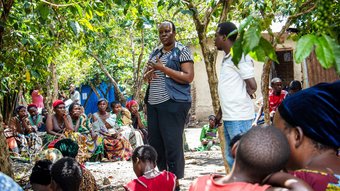
Photo taken during an earlier WAHAFA project in Kenya.
 Riverine flood