- Africa
- Madagascar
 Cyclone / hurricane / tropical storm / typhoon
Getting ahead of Tropical Cyclone Gezani in Madagascar: the Malagasy Red Cross Society activates its EAP for cyclones
The Malagasay Red Cross Society (Croix-Rouge Malagasy/CRM) activated its early action protocol (EAP) for cyclones on 9 February 2026, after the Directorate-General for Meteorology (Direction Générale de la Météorologie/DGM) issued an alert for a potential severe tropical cyclone.
CRM volunteers and community-based response teams, known locally as Équipes Locales de Secours, have since been delivering anticipatory actions at the community level, in Fenerive Est and in Toamasina (Tamatave I); these teams had been pre-equipped with early-warning-system kits. The actions are being implemented in close coordination with the Regional Risk and Disaster Management Committee (Comités Régionaux de Gestion des Risques et des Catastrophes/CRGRC), and at the request of the National Office for Risk and Disaster Management (Bureau National de Gestion des Risques et des Catastrophes/BNGRC).
Early warnings and evacuation support
The actions focused on disseminating early warnings and providing evacuation support. Early warnings were broadcast via local radio stations, while teams conducted 600 door-to-door visits to ensure the warnings were understood. In total, these reached an estimated 80,000 to 100,000 people, significantly increasing public awareness of the risks of the coming cyclone. During the house-to-house visits, CRM volunteers also helped people to prepare for the cyclone, including assisting those unable to evacuate independently.
At the same time, CRM worked with local authorities to establish and organize eight evacuation sites, with its volunteers deployed to assist with site management and headcounts for the Ministry of Population, Social Protection and Promotion of Women. In Fenerive Est, dignity kits were distributed to women and girls staying in evacuation centres. These contain washable sanitary pads (5), washable underwear (5), a pair of foldable scissors, a sarong, a towel, toothbrushes (2), a tube of toothpaste and a storage bag.
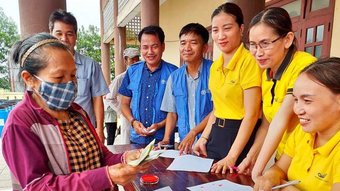
In Toamasina, CRM volunteers also supported other humanitarian partners, including the World Food Programme, in distributing cash. Prior to the cyclone making landfall, 630 households received cash assistance so they could buy essential supplies and take protective measures.
Images from the activation


How was the EAP activated?
The EAP for cyclones was activated on 9 February, after forecasts confirmed Gezani's intensification into a Severe Tropical Storm, with a high chance of making landfall as an Intense Tropical Cyclone (with gusts up to 245 km/h) within 48 to 72 hours.
The decision to activate an EAP is based on pre-defined trigger thresholds. In this case, the following thresholds were used:
- Pre-activation occurs when at least one forecast – from the DGM, the Regional Specialized Meteorological Centre for Tropical Cyclones of La Réunion, or the European Centre for Medium-Range Weather Forecasts – indicates a greater than 50 per cent probability of landfall of a tropical cyclone (with ‘tropical storm’ strength or higher) within seven days.
- A full activation is triggered when the DGM forecasts landfall of a tropical cyclone, with wind speeds exceeding 118 km/h, within 48 to 72 hours.
Between 24 and 48 hours before expected landfall, forecasts are reassessed to confirm, refine or stop the activation process. If the cyclone’s trajectory changes significantly and communities have not yet been mobilized, distributions can be halted and items returned to warehouses. However, once communities are informed and engaged, this ‘stop mechanism’ is not applied to avoid creating any social tension around the actions.
A challenging operational context
This activation took place in a highly challenging operational context. At the same time, CRM was responding to a monkeypox (Mpox) outbreak, the impacts of Cyclone Fytia and widespread flooding across the country. The short lead time between the forecast being confirmed and the expected landfall also limited the time available for implementing the actions.
Tropical Cyclone Gezani, which made landfall on 11 February, led Madagascar to declare a national disaster. Severe winds, flooding and coastal inundation affected 16 districts across 4 regions, with provisional reports indicating at least 31 deaths, with more than 250,000 people affected, including nearly 7,000 displaced. More than 17,000 houses have been destroyed and over 36,000 damaged, while schools and other infrastructure have also been destroyed. These impacts have compounded people’s vulnerability in areas already hit by previous cyclones and heavy rainfall. As a result, national authorities have called for international assistance as response operations continue.
Gezani demonstrates the increasing frequency and intensity of climate-related shocks in Madagascar. As extreme events become the norm, anticipatory action must shift from a project-based approach to a sustainable, institutionalized system within national structures, supported by predictable financing, ongoing readiness and strong coordination frameworks.
Anticipatory action within the Red Cross Red Crescent Movement
With its anticipatory action approach, the Red Cross Red Crescent Movement is shifting from reactive to proactive disaster management, using forecast-based triggers, EAPs and pre-defined funding. This locally led approach – with National Societies as the central actor – builds communities’ resilience and contributes to the integration of anticipatory action into national systems for disaster risk management.
Madagascar’s EAP for cyclones received technical support from the German Red Cross, the Red Cross Red Crescent Climate Centre and HeiGIT, with funding provided by the Deutsche Bank Stiftung and the German Federal Foreign Office.
Thanks to Bella Randrianarinaivo, Njaratiana Ifanjaharimanana and Herintsoa Tsioharana Rakotomanga (CRM) and Enrique Bermejo Dotor and Anita Auerbach (German Red Cross) for their inputs to this article.
For further information about this activation, contact Miyo Rabaritsimba, disaster manager (+261 3212 72973) or Serge Njaratiana, anticipatory action focal point (+261 0321 263003).
 Cold wave / heavy snowfall