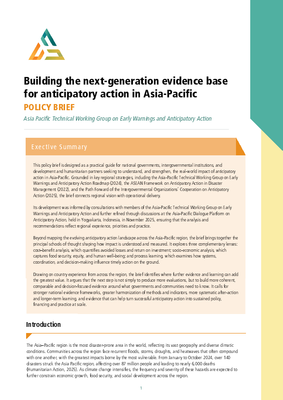
Building the Next-Generation Evidence Base for Anticipatory Action in Asia-Pacific
This policy brief is designed as a practical guide for national governments, intergovernmental institutions, and development and humanitarian partners seeking to understand, and strengthen, the real-world impact of anticipatory action in Asia-Pacific. Grounded in key regional strategies, including the Asia-Pacific Technical Working Group on Early Warnings and Anticipatory Action Roadmap (2024), the ASEAN Framework on Anticipatory Action in Disaster Management (2022), and the Path Forward of the Intergovernmental Organizations’ Cooperation on Anticipatory Action (2025), the brief connects regional vision with operational delivery.
Drawing on country experience from across the region, the brief identifies where further evidence and learning can add the greatest value. It argues that the next step is not simply to produce more evaluations, but to build more coherent, comparable and decision-focused evidence around what governments and communities need to know. It calls for stronger national evidence frameworks, greater harmonization of methods and indicators, more systematic after-action and longer-term learning, and evidence that can help turn successful anticipatory action into sustained policy, financing and practice at scale.
Publish Date
August 18, 2026
Resource Type
PDF, 4.44 MB
Authors
Asia Pacific Technical Working Group on Early Warnings and Anticipatory Action
Year
2026
Region
Asia, Central Asia, Oceania
Content Type
Briefing sheet / factsheet
Thematic Area
Evidence
 Drought / dry spell