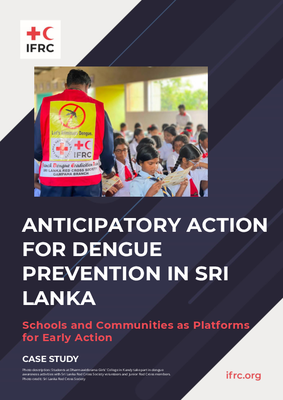
Anticipatory Action for Dengue Prevention in Sri Lanka: Schools and Communities as Platforms for Early Action
This case study explores how the Sri Lanka Red Cross Society is applying anticipatory action to dengue prevention through a simplified Early Action Protocol developed with the National Dengue Control Unit and support from IFRC.
The approach combines meteorological forecasts and epidemiological surveillance to enable preventive action before dengue transmission intensifies. A particular feature is the use of schools and communities as platforms for early action, including school-based awareness activities, clean-up campaigns, dengue prevention circles, household outreach, community surveillance and volunteer mobilisation.
The case study highlights the potential of anticipatory action to strengthen prevention around children and communities while supporting safer and more resilient school environments. It also considers opportunities to further strengthen meaningful child participation, inclusion and vulnerability analysis within anticipatory action design and implementation.
This case study was originally published on the IFRC website.
Publish Date
September 01, 2026
Resource Type
PDF, 452.15 KB
Authors
Sri Lanka Red Cross Society
Year
2026
Country
Sri Lanka
Region
Asia
Content Type
Case study
Thematic Area
Activation, Evidence, Health
Organization type
Red Cross Red Crescent Movement
Hazard
Disease outbreak / epidemic
 Drought / dry spell