
- Africa
- Mozambique
 Flood
Flood
Partners in Mozambique act in anticipation of floods
The 2025/26 rainy season in Mozambique began with intense downpours, especially in the central and northern areas. On 27 December 2025, the National Institute for Disaster Risk Management and Reduction formally triggered anticipatory actions for floods in the Licungo River Basin, Zambezia Province, after the thresholds for this region were reached.
Based on this government-led activation, organizations including the Mozambique Red Cross Society and the World Food Programme Mozambique supported the implementation of pre-agreed anticipatory actions to protect those most at risk from the rising floods. Strong coordination between government stakeholders, local authorities and community leaders ensured timely access to at-risk communities and the effective implementation of the actions, which included:
- the evacuation of more than 5,000 people in Maganja da Costa District, Zambezia Province, to temporary accommodation centres
- community-sensitization and evacuation-preparedness activities
- early warning messages that reached more than 500,000 people
- the provision of food assistance (7-day kits)
- the provision of plastic bags to protect essential household assets
- the distribution of pre-positioned relief items (e.g., first aid kits, mosquito nets) and water, sanitation and hygiene items (e.g., chlorine to purify water, buckets, jerrycans).
Partners support the implementation of anticipatory actions
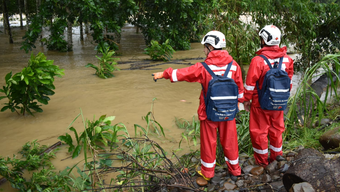
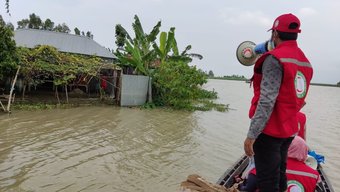
Photos 1-5 © WFP Mozambique; photos 6-7 © Mozambique Red Cross Society.


A flexible approach to triggering an EAP
All early action protocols (EAPs) developed by National Red Cross and Red Crescent Societies include a trigger threshold; once reached, the EAP is activated and the International Federation of Red Cross and Red Crescent Societies (IFRC) releases pre-agreed funds from its Disaster Response Emergency Fund.
For this activation, however, the Mozambique Red Cross Society followed the official activation declaration by the National Institute for Disaster Management and Risk Reduction. This marks the first instance of an EAP being activated in this way, following the IFRC updating its procedures to enable this.
Based on the government’s activation, the IFRC provided released 178,853 Swiss francs (approximately 225,000 US dollars/193,000 euros), which was used by the Mozambique Red Cross Society to support around 10,000 people in the Licungo River Basin.
The team experienced some logistical challenges during the activation. For example, access to some communities was only possible by river, which required them to transfer relief items by boat. However, the activities were all implemented successfully within the five-day window between the forecast and the floods peaking.
This activation, the second for floods in 2025, benefitted from technical support from partners within the Red Cross Red Crescent Movement, including the German Red Cross, which enhanced the quality and timeliness of the actions.
Thanks to Melanie Ogle (IFRC), Sérgio Nhaúle (Mozambique Red Cross Society), Ria Jusufbegovic and Sören Schneider (German Red Cross), and Benvindo Nhanchua and Marcia Penicela (WFP), for their inputs to this article.
 Drought / dry spell
 El Niño / La Niña

 Cyclone / hurricane / tropical storm / typhoon