 Cyclone / hurricane / tropical storm / typhoon
Mozambique holds its first national after-action review of anticipatory actions for cyclones
On 18 and 19 June 2025, the government of Mozambique, through the National Institute for Disaster Management (INGD), convened the country’s first national after-action review on cyclones. This followed the first ever activation of government-led anticipatory actions for cyclones during the 2024/25 cyclone season, particularly for cyclones Chido, Dikeledi and Jude; combined, these affected over one million people in the provinces of Nampula and Cabo Delgado.
The after-action review focused on the lessons learned from this activation, with the institutions involved reflecting on what was planned, what actually happened, and how to improve early warning and anticipatory actions in the future. Over 40 participants attended, coming from the government, humanitarian organizations, United Nations agencies and technical institutions; these included the Mozambique National Institute of Meteorology (INAM), the National Directorate of Water Resources Management (DNGRH), WFP, OCHA, the Mozambique Red Cross Society and the International Federation of Red Cross and Red Crescent Societies.
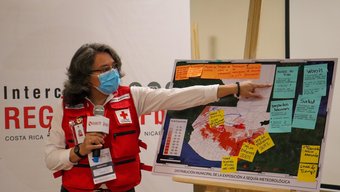
Get a glimpse into the after-action review held in Mozambique in June 2025

Major outcomes from the review
Areas of discussion over the two days included the effectiveness of anticipatory action plans and protocols, as well as forecasts and triggers, and the operational challenges in implementing anticipatory actions. The participants agreed that while pre-agreed plans provide a solid foundation for actions, there are still areas for improvement. These include enhancing operational efficiency through strategic pre-positioning of supplies, speeding up financial flows, and ensuring that forecasts and triggers are better aligned.
Despite these challenges, the review demonstrated strong institutional commitment towards anticipatory action and to the need for cross-sector collaboration to enhance systems moving forwards. The participants jointly identified a set of actionable priorities to achieve this, including:
extending the lead times for activations to 96 hours before a cyclone makes landfall, to allow more time to implement the actions
refining and updating trigger thresholds for cyclones to reflect the evolving dynamics of these hazards
enhancing the coverage of the action plans and protocols, from pilot districts to provincial-level readiness
adapting assistance models to go beyond traditional accommodation centres.


Improving the process together
The participants noted that the structure of the workshop, which focused on openness and creating a participatory atmosphere, enabled the diverse actors assembled to reflect on shared challenges and coordinate practical improvements.
Mozambique’s first after-action review for cyclones is a valuable example of how government-led reviews can drive improvements in preparedness and anticipatory action, and ensure that lessons are not only learned, but acted upon. The National Technical Working Group for Anticipatory Action will reconvene soon to validate the recommendations and use them to strengthen and update anticipatory action protocols ahead of the 2025/26 cyclone season. This will ensure that these frameworks are robust in time for future activations.
The after-action review was organized by the National Institute for Disaster Management (INGD) of Mozambique in close collaboration with the World Food Programme. It was facilitated by the Anticipation Hub as part of a pilot initiative to strengthen national-level reviews of anticipatory action and institutional learning. The structured approach and use of interactive tools were well received by the participants, helping to gain insights from across the sectors involved in the activation.