
- Asia
Eyes on the horizon, feet on the ground: The Asia-Pacific Dialogue Platform on AA kicks off in Bangkok
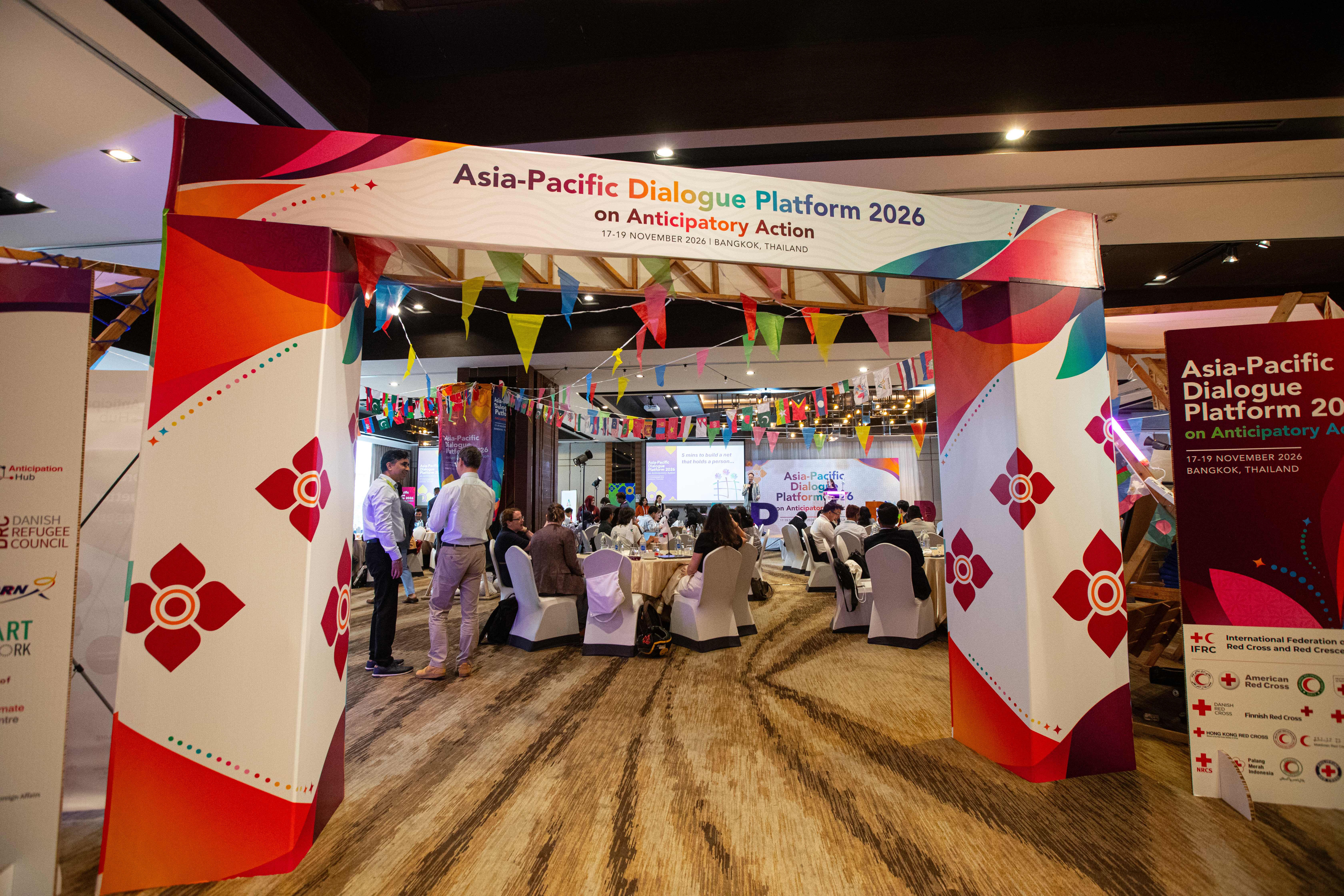
The 2026 Asia-Pacific Dialogue Platform is taking place from 17 to 19 November in Bangkok, Thailand.
Eyes on the horizon, feet on the ground: The Asia-Pacific Dialogue Platform on AA kicks off in Bangkok
Under the theme “Eyes on the Horizon, Feet on the Ground: Powering Early Warning Systems and Scaling Anticipatory Action”, the 2026 Asia-Pacific Dialogue Platform, taking place from 17 to 19 November in Bangkok, Thailand, focuses on strengthening the links between early warning systems and anticipatory action across the region.
A growing region, but challenges remain
Anticipatory action (AA) has expanded significantly across Asia-Pacific in recent years. According to the latest regional mapping presented during the opening session, the number of anticipatory action frameworks increased by 72% between 2023 and 2025, reaching 169 frameworks across 17 countries. The mapping also recorded 29 activations targeting more than 1.3 million people.
Yet the discussions highlighted that growth alone is not enough. With different organizations using different forecasts, triggers and financing arrangements, there is a growing need to harmonize approaches and strengthen government-led coordination. Nearly half of the frameworks identified in the mapping still lack guaranteed pre-arranged financing for activation.
Bridging the gap between warnings and action
Throughout the first day, participants explored how early warning systems (EWS) and anticipatory action can work more closely together.
EWS and AA are closely connected, but they are not quite the same. EWS bring together the institutions, knowledge and capacities needed to identify risks, forecast hazards, communicate warnings and enable people to prepare and respond. AA is an approach that builds on these systems by linking forecasts and risk information to (pre-)agreed triggers, and financing. In short, AA helps make the connection between early warnings and early action more systematic.
While the EWS community has traditionally placed strong emphasis on forecasting and warning dissemination, with hydrometeorological agencies playing a central role, the AA community has focused on defining actions to be taken ahead of a hazard and securing the financing to implement them. AA has largely been driven by humanitarian actors, with national disaster risk management authorities increasingly taking the lead. Day one's discussions explored how these overlapping communities can work more closely together to achieve their shared ambition: protecting at-risk communities before the predicated impact of a hazard turns into a disaster.
“Our goal is to ensure that the EWS and AA partners have a common understanding and that national authorities are in a position to issue forecasts for AA within the framework of their national EWS” says Raymond Zinng, Regional Focal Point Asia-Pacific, Anticipation Hub / Co-Chair Asia Pacific Technical Working Group on Early Warnings and Anticipatory Action.
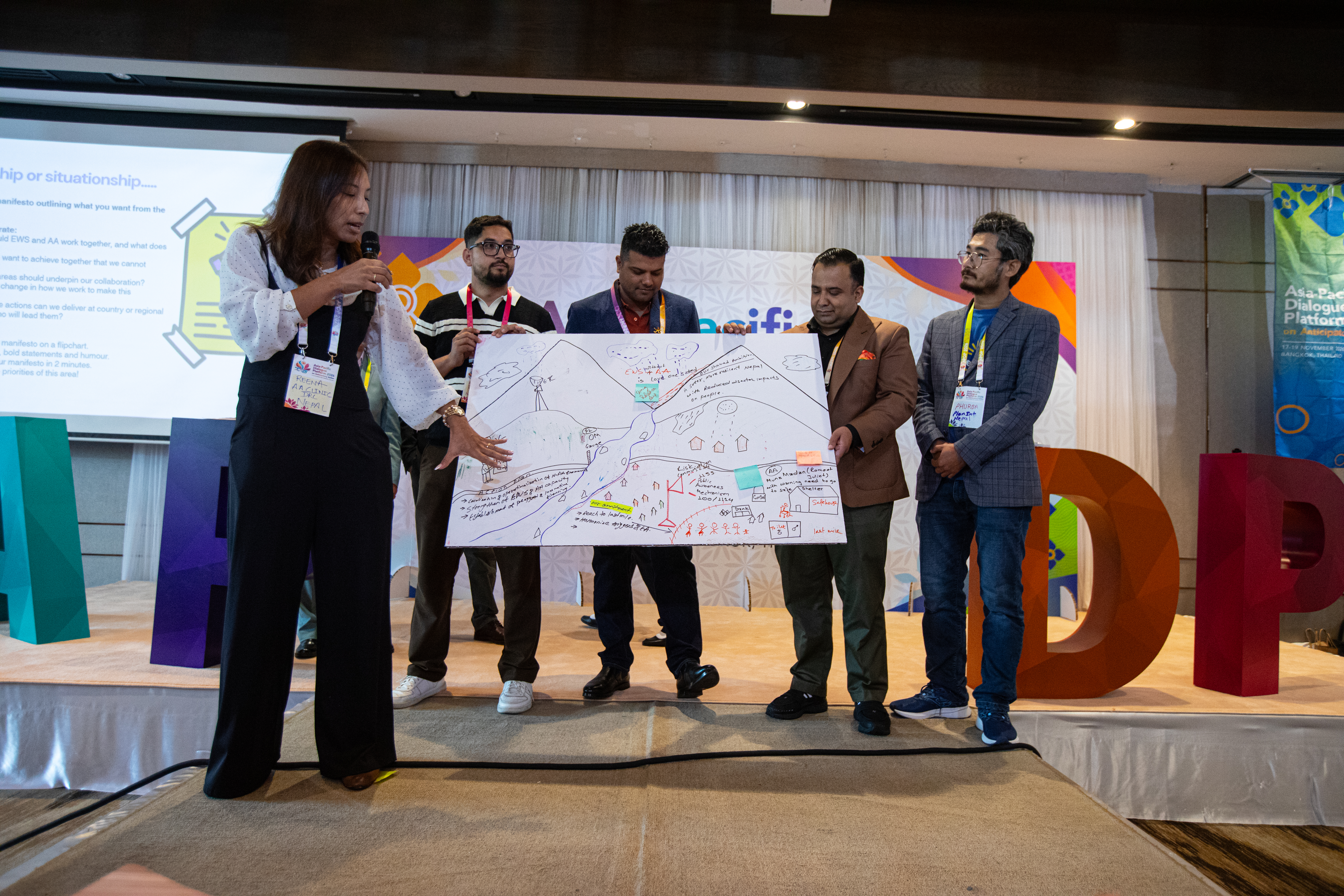
During an interactive exercise, country groups reflected on their shared ambitions and identified concrete steps to strengthen the links between EWS and AA. Nepal emphasized aligning its national AA framework with the Early Warnings for All roadmap, while strengthening local capacities and securing pre-arranged financing. Afghanistan highlighted the need to bring coordination structures for EWS and AA closer together, connecting technical forecasting capacities with humanitarian action and financing. The Philippines focused on harmonizing forecasting thresholds and embedding AA into government systems, while Bangladesh stressed the importance of linking national coordination with locally led decisions and ensuring that warnings translate into actions communities can take.
Together, these examples illustrate that bridging the gap requires not only better forecasts, but also stronger institutional coordination, clear responsibilities and financing that enables timely action.
From forecasts to action: harmonizing triggers
A second plenary, organized trigger subgroup of the Regional Asia Pacific Technical Working Group on Early Warnings and Anticipatory Action, took a closer look at one of the key challenges to scaling up AA in the region: harmonizing triggers. Different organizations often rely on different forecasts, thresholds and geographical scales to determine when to act. Many of these triggers have also been developed in parallel to national EWS, making coordinated action more challenging.
Participants highlighted the need to move towards more harmonized, government-led systems, with better data sharing, stronger impact-based forecasting and clearer responsibilities for activation decisions. Country discussions illustrated the practical challenges: Indonesia emphasized the difficulty of aligning triggers across its diverse islands and climate zones, while Bangladesh highlighted gaps in highlighted gaps in information exchange across sectors, actors and neighbouring countries, referring to a 2024 flood experience in southeastern Bangladesh.
The discussions also identified priorities for regional support, including technical guidance, peer learning and improved data-sharing arrangements. These inputs will help inform the next workplan of the trigger subgroup.
As the Dialogue Platform continues, one message stands out: scaling up anticipatory action is not just about developing more frameworks, but about building more integrated, coordinated and sustainable systems that turn early warnings into timely action.
________________________________________
The 2026 Asia-Pacific Dialogue Platform on Anticipatory Action is organized by the Asia Pacific Technical Working Group on Early Warnings and Anticipatory Action and the Anticipation Hub, with financial support from DG ECHO, German Federal Foreign Office and the Ministry of Foreign Affairs of the Netherlands.