 Population movement
Anticipating the impacts of population movement: new resources from the IFRC
In recent years, several humanitarian organizations have been exploring the potential for anticipating the humanitarian challenges experienced by people on the move: those who have been displaced or who are migrating. A new report, published by the International Federation of Red Cross and Red Crescent Societies (IFRC), summarizes evidence and ideas on how this can be done.
The report is based on two years of collaborative work by a dedicated IFRC working group. It also draws on the experiences of National Red Cross and Red Crescent Societies that already anticipate these impacts, including the Colombian Red Cross, the Red Crescent Society of Djibouti and the Honduran Red Cross.
Important considerations for anticipating population movement include the following:
- Flexibility is essential: rigid definitions (e.g., of movement types or thresholds) risk excluding affected groups.
- Triangulation builds confidence: for example, integrating multiple, diverse data sources mitigates uncertainty.
- Learning must remain iterative: anticipatory action for population movement remains emergent, and continued experimentation and innovation are needed.
Alongside the report, the IFRC has also developed a template for National Societies seeking to develop a simplified early action protocol for population movement.
“These documents represent a significant step forward for this topic, and for anticipatory action more broadly,” said Malika Noisette, the Disaster Response Emergency Fund (DREF) anticipatory action senior officer at the IFRC. “The next steps include testing these materials across different contexts and further reviewing the trigger-based approach for population movement.”
The working group included colleagues from several units at the IFRC Secretariat: the DREF; the Migration and Displacement Team; the Climate, Urban, Resilience and Environment Team; the National Society Preparedness Team; and the Information Management Team. It also included representatives from National Societies including the American Red Cross, the Australian Red Cross, the British Red Cross, the Danish Red Cross, the German Red Cross and Netherlands Red Cross, as well as the Red Cross Red Crescent Climate Centre. The working group was co-led by the IFRC-DREF and Australian Red Cross, and supported by Cyandra Carvalho, an external consultant.
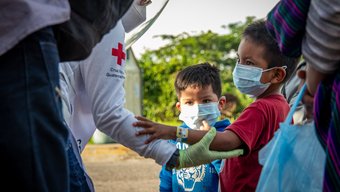
Thanks to Catalina Torres, IFRC, for her help with the article. Photo by Natalie Acosta/German Red Cross; note that this was taken during an evaluation for drought, not population movement.

 Conflict
 Other
Other

