
- Africa
- Mozambique
 Drought / dry spell
A forecast is not a decision: how Mozambique sets its drought triggers
Since 2019, Mozambique’s National Institute of Meteorology (INAM) has been defining and calibrating triggers for Mozambique’s early warning system for drought. A new open-source tool, built by design engineers from Harvard University with INAM and the World Food Programme, is designed to make it easier to sustain and institutionalize this knowledge.
A forecast is not a decision: how Mozambique sets its drought triggers
A seasonal forecast can give the probability of a failing rainy season – but cannot make a decision on when or how best to proceed. If a country acts on a low probability, it risks committing scarce shock-mitigation resources to what may be a mild season, draining funds and eroding trust in the system. Wait for near certainty, and the window for taking mitigative actions has already closed.
Somewhere between the two, a line must be drawn. That line is the trigger for anticipatory action.
How a trigger gets defined
In Mozambique, the National Institute of Meteorology (INAM) coordinates decisions on where to set triggers for anticipatory actions, for drought and other hazards. Since 2019, the World Food Programme (WFP) has been working with INAM to define a trigger-calibration process for the country's drought-monitoring system; together, they work within a national technical working group that brings together disaster management, agriculture, water, food security and humanitarian response.
The underlying methodology for triggering actions for drought, known as ‘Ready, Set, Go!’, was developed jointly by INAM and WFP and published in peer-reviewed journals (see Nobre et al., 2023; 2024). Trigger values are formally documented in the country’s Anticipatory Action Plan for Drought, which makes them government-owned and operational.
Establishing this process took years of effort – but this has paid off. After the technical working group was created in 2020, the first district-level triggers were approved in 2022. The first activation for drought came in the 2023/24 season and, over the past two dry seasons, more than 600,000 people in Mozambique have benefitted from anticipatory actions ahead of drought.
Watch: A product pitch providing context and an overview of the process
What ownership of triggers requires in practice
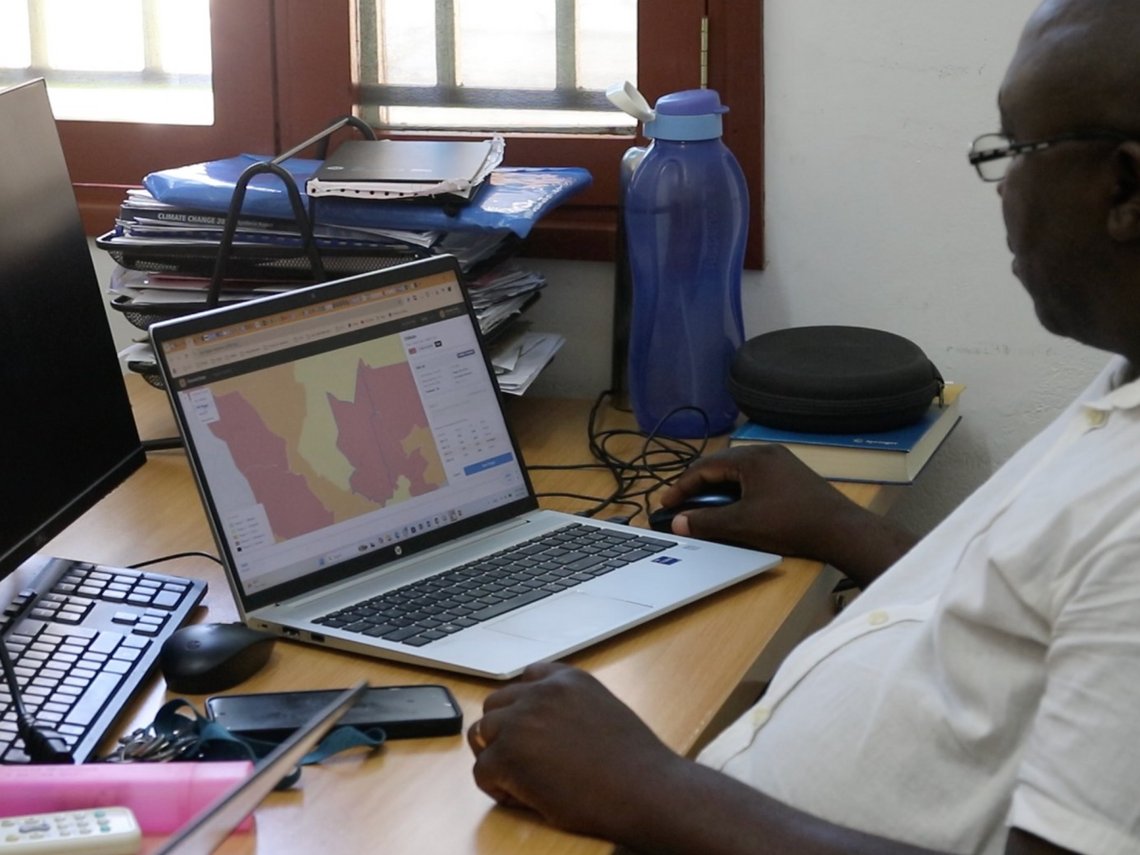
Trigger calibration is analytically demanding. It runs on decades of records: CHIRPS rainfall observations and ECMWF SEAS5 hindcasts from 1981 onwards. Against these, forecast skill can be verified for a given district and lead time.
Analysts then test potential triggers against the record. For each district, implementation window and level of drought severity, they score thousands of possible trigger values against what actually happened, and keep only the ones that meet performance criteria the technical working group agrees upon in advance.
In practice, this means a trigger has to catch enough of the real droughts – and it also has to avoid firing so often that agencies stop trusting it. This work currently runs through Python notebooks, spreadsheets and the expertise of a small number of specialists.
The method is sound and the results are well documented. What is harder is the operation. Every step of this process needed analysis that only a small number of specialists from WFP knew how to run. Furthermore, the workflow is difficult to see end to end and difficult to hand over. It is also slow to reproduce in a new district or a new country. The method is not the constraint; rather, the number of trained specialists needed to run it.
Building the workflow into software
To address this constraint, a new tool was needed. Ground State is an open-source tool developed by INAM, WFP and design engineers from Harvard University, which packages the full calibration workflow into a tool that a national meteorological service can run on its own, reducing the dependence on outside experts.
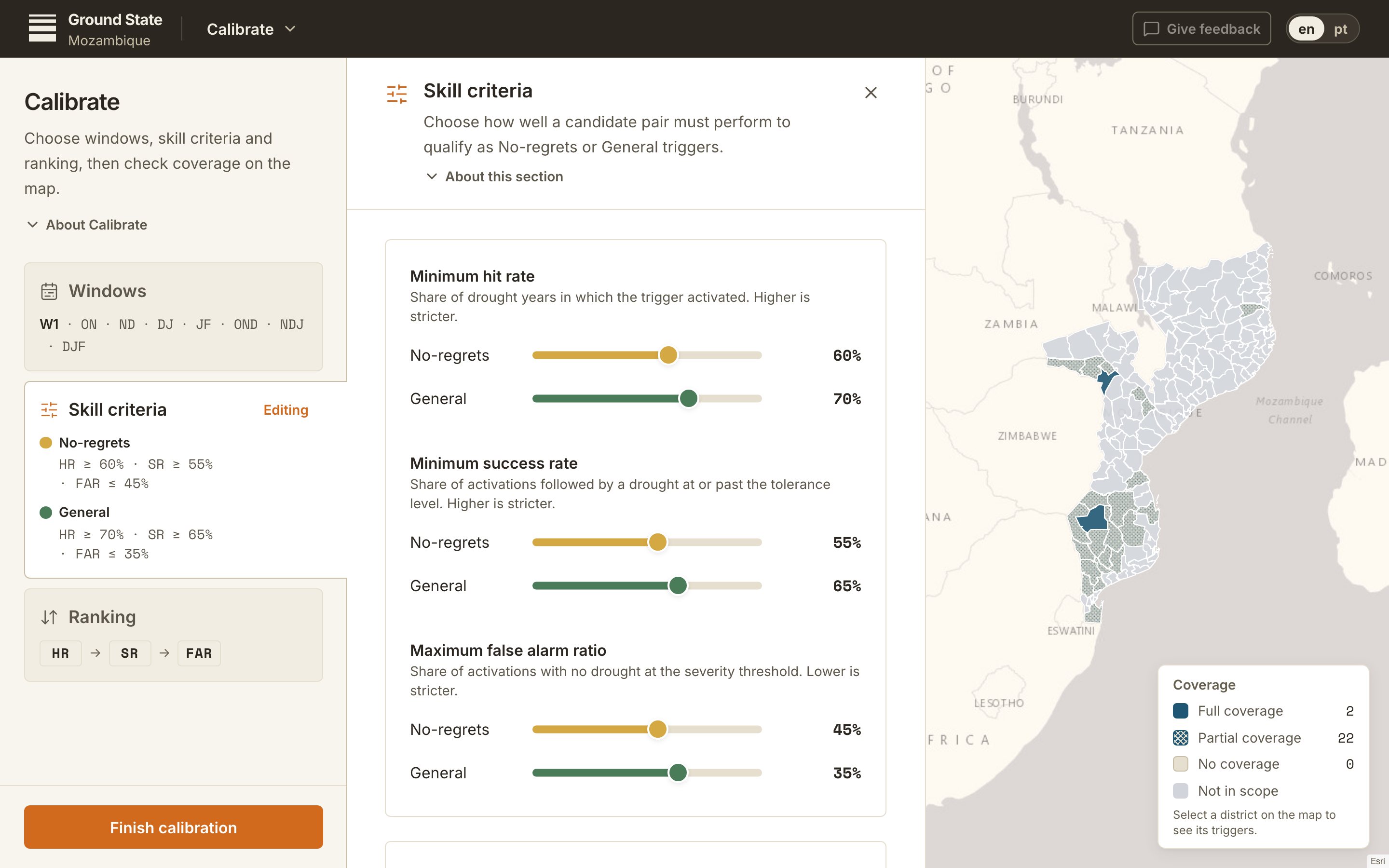
The tool grounds every decision in the country’s own hydrometeorological records. A user moves a threshold on an interactive map and sees how that trigger would have performed across the historical record: which droughts it would have caught and which alerts would have been false alarms, district by district and season by season. It covers the full annual cycle, from pre-season calibration through in-season monitoring to after-season review.
Every confirmed configuration in Ground State records who confirmed it, their institution and the date, which gives a country’s working group an auditable record of its own decisions. In Mozambique, this means that the science and decision-making about when to trigger actions for drought stay with INAM and the technical working group.
What the design research revealed
Ground State came out of more than 100 interviews and working sessions with experts working on drought response and anticipatory action. Many of these took place with INAM meteorologists and WFP analysts in its headquarters in Rome, Italy; others with disaster-management officials at Mozambique’s National Institute of Disaster Management (INGD) and counterparts at the Food and Agriculture Organization of the United Nations and the Mozambique Red Cross Society.
The specialists who would run the tool continued to test it as it was built. This meant it was designed to be integrated into existing anticipatory action processes and workflows. As a result, Ground State proposes no skill criteria, thresholds, district priorities or risk attitudes; instead, it shows the trade-offs inherent in anticipating droughts and makes it easier for the technical working group to make an informed decision.
The design process revealed a second use for the tool. Calibration that lives in software, instead of in a few people's heads, leaves a record of why each trigger was set. In other words, it survives staff turnover and makes it easier to bring new analysts up to speed on both the process and historical decisions.
A tool built to reduce dependency on outside specialists can leave an institution dependent on whoever maintains the tool internally. The licence for Ground State partly resolves this: it is designed for release under Apache 2.0, so any meteorological service will be able to read the code and change it. This means it can keep running the tool after the original team has moved on, and anyone working on the same problem can build on it or use it outright.
Another potential issue is ongoing maintenance, as someone has to keep the software current, for example when ECMWF replaces its SEAS5 system or when CHIRPS changes how it publishes data. The team behind Ground State is establishing a non-profit arm to take these tasks on.
What it would take to scale
The need for calibrated triggers extends beyond Mozambique. More than 80 countries face chronic drought and only a third have systems in place to act ahead of it. This gap is not explained by a shortage of available methods; Mozambique’s ‘Ready, Set, Go!’ approach is published, peer-reviewed and operational. Instead, the gap is explained (at least partly) by the lack of analytical capacity to define triggers for a specific geography, and to keep defining them as the record grows and staff move on. Every country that adopts the methodology today begins from the same small pool of specialists.
To be effective in the long term, early warning systems need to be owned by the institution that will still be running them in ten years. Software can meet part of this challenge, but these systems also need to be operable by national institutions without permanent external support. Mozambique’s experiences demonstrate how this can be achieved.
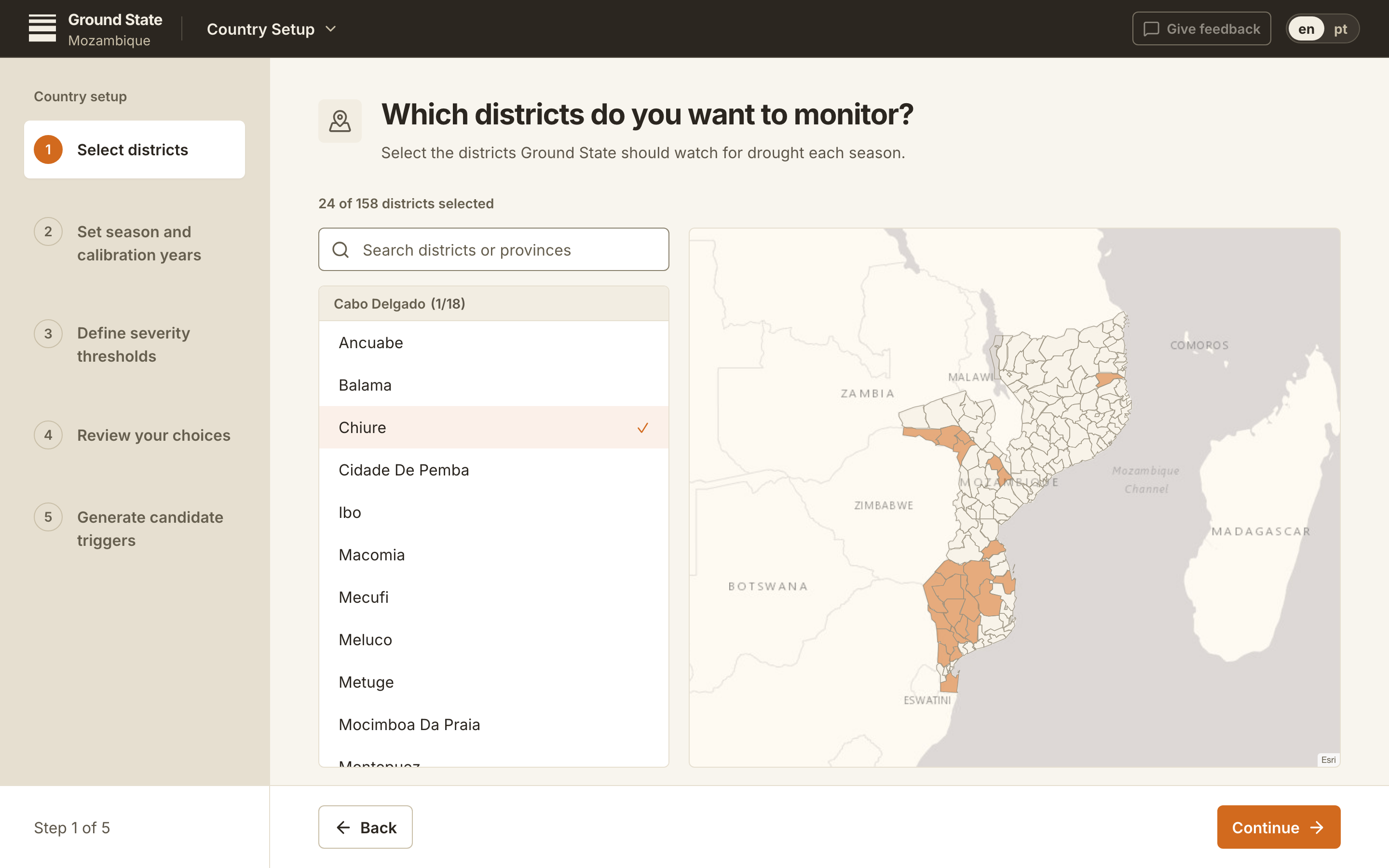
Images from the new tool
This article was written by Mitul Iyengar and Luke Fiorante, Semitone.