
Anticipatory Action for Dengue Prevention in Sri Lanka: Schools and Communities as Platforms for Early Action
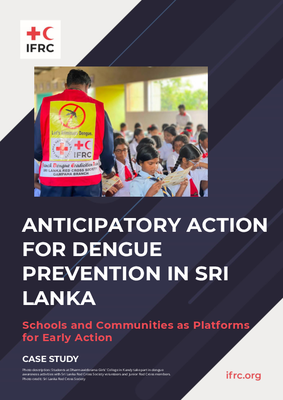
This case study explores how the Sri Lanka Red Cross Society is applying anticipatory action to dengue prevention through a simplified Early Action Protocol developed with the National Dengue Control Unit and support from IFRC.
The approach combines meteorological forecasts and epidemiological surveillance to enable preventive action before dengue transmission intensifies. A particular feature is the use of schools and communities as platforms for early action, including school-based awareness activities, clean-up campaigns, dengue prevention circles, household outreach, community surveillance and volunteer mobilisation.
The case study highlights the potential of anticipatory action to strengthen prevention around children and communities while supporting safer and more resilient school environments. It also considers opportunities to further strengthen meaningful child participation, inclusion and vulnerability analysis within anticipatory action design and implementation.
This case study was originally published on the IFRC website.
Date de publication
septembre 01, 2026
Type de ressource
PDF, 452.15 Ko
Auteurs
Sri Lanka Red Cross Society
Year
2026
Pays
Sri Lanka
Région
Asie
Type de contenu
Étude de cas
Thème
Activation, Preuves, Santé
Type d'organisation
Mouvement de la Croix-Rouge et du Croissant-Rouge
Risques
Foyer de maladie / épidémie

 Conflit armé
 Inondation