 Cyclone / hurricane / tropical storm / typhoon
The Philippine Red Cross acts to protect people ahead of Super Typhoon Fung-wong
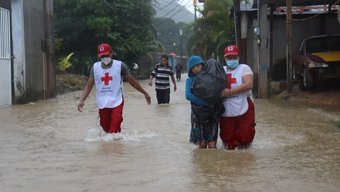
The Philippine Red Cross activated its early action protocol (EAP) for typhoons after forecasts for Super Typhoon Fung-wong reached the trigger thresholds. It supported communities through the distribution and installation of shelter-strengthening kits for 224 selected households (1,120 people), which took place in the in the areas considered most at risk in Quirino, Isabela and Quezon-Lucena provinces. It also shared early warning messages throughout these areas.
These actions were supported by 20,725 Swiss francs (25,751 US dollars/22,291 euros) of pre-agreed financing from the Anticipatory Pillar of the Disaster Response Emergency Fund, which is managed by the International Federation of Red Cross and Red Crescent Societies (IFRC).
Anticipating the many impacts of Super Typhoon Fung-wong
Several other organizations acted to anticipate the impacts of the super typhoon:
- The Food and Agriculture Organization of the United Nations, alongside the Department of Agriculture – Special Area for Agricultural Development and the Bureau of Fisheries and Aquatic Resources, moved fishing equipment and boats to safer locations, evacuated livestock to safe areas, and supported the early harvesting of rice crops, among other activities.
- The World Food Programme and the Department of Social Welfare and Development provided anticipatory cash to more than 42,000 at-risk households (210,000 people) in five provinces across the Cagayan Valley and Central Luzon regions.
- Oxfam Pilipinas provided cash transfers to at-risk households.
How the super typhoon rapidly developed
Super Typhoon Fung-wong, known in the Philippines as Uwan, intensified rapidly in just a few days.
4 November 2025:
- A low-pressure area being monitored near the Philippines is seen to have developed into a tropical depression.
6 November 2025:
- Tropical Depression Fung-wong is recorded as having intensified into a tropical storm.
7 November 2025:
- Tropical Storm Fung-wong has intensified into a severe tropical storm, with maximum sustained winds of 95 km/h near the centre, gustiness of up to 115 km/h, with strong winds extending up to 720 km from the centre.
- The Philippine Atmospheric, Geophysical and Astronomical Services Administration (PAGASA) estimates the storm’s centre to be 1,500 km east of northeastern Mindanao or 1,470 km east of Eastern Visayas.
- It is projected to continue its west-north-westward path for most of the forecast period, with a growing likelihood of landfall on 10 November in Northern or Central Luzon (while noting the often considerable uncertainty in predicting the track and intensity for days 4 and 5).
- The storm is anticipated to intensify further, possibly reaching the category 'super typhoon', with wind speeds above 185km/hr, by 9 November.
The EAP activation notice has further details of this timeline.
Reaching the trigger to act
The EAP was activated following a typhoon advisory from PAGASA, released on 7 November, which forecast that wind speeds would reach 195km/hr within the next 96 hours.
This was the first activation of the EAP since its revision in 2024. It was not activated for Typhoon Kalmaegi (known in the Philippines as Tino), which hit the country the previous week. The trigger for activating the EAP is based on wind speeds, which were not met for Kalmaegi; in fact, the widespread damage caused by the earlier typhoon was mostly due to the heavy rain and floods it brought, and the subsequent landslides.
This article was updated on 10 and 11 November with further details about the activation.
The EAP for typhoons was developed by the Philippine Red Cross, with support from the German Red Cross and the IFRC, and funding from the German Federal Foreign Office.
Thanks to Gabrielle Roudat, Melanie Ogle, Simon Quesseveur, Stefanie Lux and Verena Kausche for their inputs. Photos by Philippine Red Cross.
Photos by the Philippine Red Cross.