
 Flood
Flood
Nigeria recently took a major step forward in disaster anticipation and preparedness by holding a National After-Activation Review of an intervention in Adamawa State in September, when the joint anticipatory action framework for floods was activated.
From 25 to 27 November 2025, the Office of the Vice-President convened over 50 participants in Yola, Adamawa State, including: representatives from the government, including the Ministry of Agriculture and Livestock, the Ministry of Environment, the Nigeria Hydrological Services Agency (NIHSA), the FCT Emergency Management Agency and the State Emergency Management Agency; United Nations (UN) agencies, including the Food and Agriculture Organization of the United Nations (FAO), the International Organization for Migration (IOM), the United Nations Children's Fund (UNICEF), the UN Office for the Coordination of Humanitarian Affairs (OCHA), the World Health Organization and the World Food Programme (WFP); the International Red Cross and Red Crescent Movement; national and international non-governmental organizations (NGOs) (including, among others, Caritas, the Center For Advocacy, Transparency & Accountability Initiative, the GOAL Prime Organization Nigeria, the Goggoji Zumunchi Development Initiative and ONSA); and technical partners.
Activating Nigeria’s joint anticipatory action framework for floods
Flooding is a recurring phenomenon in Nigeria, often resulting in loss of lives and livelihoods. Every year, many states are severely affected across the country, with negative impacts on already-vulnerable households that are exposed to high levels of climate-induced shocks, as well as conflict-related displacement and food insecurity. According to the Nigeria Emergency Management Agency's (NEMA) flood dashboard, over 1.3 million people were affected by floods in 2024; over 700,000 were displaced, while 194,634 hectares of farmland were destroyed.
Due to these impacts, floods are a major concern for the government. To address these impacts, while also responding to the need for innovation and improved efficiency with humanitarian operations, the humanitarian community introduced anticipatory action into the Nigeria 2025 Humanitarian Needs and Response Plan (priority 3): under this, around 5 per cent of the programmed resources for 2025 were intended to address cyclical events such as floods, thus reducing human suffering and saving scarce resources. This was rolled out by working closely with government agencies including the Ministry of Humanitarian Affairs, NEMA, the Nigerian Meteorological Agency and NIHSA.
This led to the development of a joint framework, Anticipatory Action Framework: Nigeria - Floods, which was approved in July 2025. This was triggered on 8 September 2025, unocking 7 million US dollars in funding (5 million US dollars from the Central Emergency Response Fund and 2 million US dollars from the Nigeria Humanitarian Fund) for preparedness activities, and for anticipatory and early actions.
Scope and triggers for the framework
The joint framework provides pre-arranged financing for riverine floods along the Benue River (Adamawa State); it is activated when the predefined forecast thresholds are reached, based on data from Global Flood Awareness System and the Google Flood Hub.
Delivery of the anticipatory actions
Within 72 hours of the framework being triggered in September 2025, WFP had delivered anticipatory multi-purpose cash transfers to over 83,500 vulnerable people in four local government authorities of Adamawa State; it also supported many of them to open their first bank accounts. Overall, multisector assistance reached roughly 350,000 people, including more than 140,000 who received multi-purpose cash. Other actions included early warning messages, which reached over 400,000 people in flood-prone areas, while more than 288,000 animals were vaccinated and dewormed to prevent disease and protect their owners' incomes.
Key insights and lessons
The National After-Activation Review examined the September activation in terms of what was planned, what actually happened and why it happened. The focus was to establish strengths and bottlenecks, and develop action plans and recommendations on how future activations can be improved. From the start, it was clear that the objective of this exercise was not only to identify how anticipatory action can be strengthened; participants also sought to underscore Nigeria’s shift toward a model of anticipatory action that is locally led, locally implemented and locally financed, with clear policy and budget signals in support of institutionalization at federal and state levels.
As Trond Jensen, OCHA, noted in the opening words, there were critical enablers for this activation. For example, cross-sector teams – which involved those working on hydrometeorology and forecasting, as well as cash, water, sanitation and hygiene (WASH), health, agriculture, protection and shelter – reported that joint planning and field coordination were vital. “Teamwork is core to the success of anticipatory action; a lot of things would have been better or different with better coordination,” noted one participant.
Lessons from the after-activation review
Institutionalization matters. Embedding anticipatory action in national policy and budget lines is essential for speed and scale.
Data and targeting must be harmonized. Shared protocols, memoranda of understanding and unified beneficiary databases reduce duplication and accelerate assistance.
Protect those most at risk. Systematically mainstream protection and ensure the inclusion of people who may be absent from social registries.
Preparedness pays. Pre-financing, pre-positioning and annual risk-reduction work (e.g., desilting) reduce costs and speed up delivery during an activation.
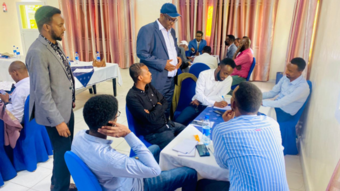
Images from the National After-Activation Review


Actionable priorities and next steps
- Policy and financing: institutionalize anticipatory action across ministries; define multi-year pooled funds that carry over if not activated; dedicate a budget for coordination and updating state operating coordination units' list in flood-prone states.
- Early warnings and triggers: issue seasonal warnings for floods by late March; refine the design of multi-layer triggers and thresholds for activations; align roles for generating and disseminating warnings.
- Targeting and accountability: adopt a harmonized targeting/verification protocol; establish a centralized community-feedback mechanism; formalize data-sharing agreements.
- Preparedness actions: schedule procurement and pre-positioning; identify evacuation and assembly sites ahead of the rainy season; plan annual desilting activities, with waste evacuation.
- Protection mainstreaming: integrate gender-based violence considerations and protection training across sectors and locations; include survivors of gender-based violence, persons with disabilities and unaccompanied/separated children in social registries, to ensure they can access social support.
Looking ahead
The National After-Activation Review produced concrete recommendations to institutionalize anticipatory action in Nigeria and strengthen coordination, as well as defining a timeline of crucial steps ahead of the next flood season. Participants agreed that the activities for next year must start now, with a rallying call for the government to take the lead and for all partners to stay engaged. The government leadership and the engagement of all partners will be central to ensuring that lessons are not only learned, but acted upon.
Advocacy messages from the event captured calls to:
- institutionalize and expand anticipatory action
- allocate resources
- scale up shock-responsive social protection and include anticipatory action in this
- update social registries with priority for flood-prone areas
- finance preparedness activities, including annual desilting and sensitization, to reduce the risk before floods peak.
Conclusions
The successful activation for floods in Adamawa State in September showed that anticipatory action is possible in Nigeria and can be expanded to other states. Further, the National After-Activation Review in November demonstrated the country’s commitment to proactive, locally led disaster risk management. The lessons and momentum from this review will guide future efforts, ensuring that communities are better prepared, protected and empowered before disaster strikes.
Assessing the methodology used for the National After-Activation Review
The National After-Activation Review was organized by the government of Nigeria in close collaboration with OCHA and WFP, with contributions from FAO, IOM, UNICEF and national NGOs, and with technical support from the West and Central Africa Regional Anticipatory Action Task Force. It was facilitated by WFP using the Anticipation Hub’s inclusive, highly participatory approach – small group rotations, plenary sharing, root-cause analysis and joint work-planning – which creates a safe space for transparent reflection and reinforces cross-sector learning.
Participants rated the facilitation highly in terms of encouraging active participation, neutral moderation and actionable outputs. An evaluation survey showed that 67 per cent rated the workshop as 'very effective', with 33 per cent rating it 'effective'. For the facilitation and workshop methodology, 77 per cent strongly agreed that it encouraged participation and actionable learning. The session on developing the work/action plan was particularly well praised – far more than any other activity – with frequent mentions that it was clear, practical and actionable; reflections on what went well/what didn’t were also repeatedly cited as useful.
In terms of future events, participants repeatedly called for broader stakeholder inclusion, for example bringing in higher-level government representatives, the private sector and donors; they also noted the need to ensure that sector leads and implementers share field experiences and best practices to enrich the process. Another request was more time (e.g., longer sessions, additional days) to allow for deeper discussions and ensure recommendations are fully covered.
Article by Silvia Pieretto, Yakoubou Mounkara Oumarou and Marcela Ricupero.


 Heavy rain

 Disease outbreak / epidemic
 Population movement