- Africa
- Chad
 Drought / dry spell

From preparedness to activation: partners act to anticipate drought in Chad
Chad has activated its anticipatory action framework for drought, unlocking 4.4 million US dollars to implement actions that aim to alleviate the worst impacts for people at risk.
From preparedness to activation: partners act to anticipate drought in Chad
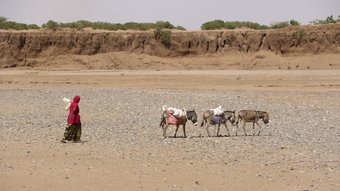
Early warnings linked to an El Niño-driven drought are prompting timely action in Chad. Based on recent seasonal forecasts, which were confirmed by national authorities, the country’s anticipatory action framework for drought was first activated on 30 April 2026, and subsequently on 9 May 2026, unlocking a total of 4.4 million US dollars from the United Nations (UN) Central Emergency Response Fund. Partners in the country have now begun to implement the anticipatory actions set out in this framework to alleviate the worst impacts for people at risk.
The actions aim to protect people’s livelihoods, food security and nutrition outcomes before the most severe impacts of the drought are felt. These include early warnings, cash assistance, repairs to water points and the distribution of climate-resilient seeds. These actions will be carried out ahead of the expected poor rainy season (June–September) and are targeting the areas forecast to be worst affected, including Bahr-el-Gazal and Kanem.
Further assistance for people affected is also being prepared, with additional funding, so that partners and activities are ready if conditions deteriorate further later in the season.
An interagency approach to anticipatory action
The anticipatory action framework is coordinated by the UN Office for the Coordination of Humanitarian Affairs (OCHA), with the actions being implemented by the Food and Agriculture Organization of the United Nations, the UN Children’s Fund and the World Food Programme.
This activation illustrates how recent efforts to strengthen Chad’s national systems for anticipatory action – including decision‑making processes, responsive partnerships, and training in how to translate forecasts into timely actions – have been worthwhile. It also confirms that anticipatory action is no longer a pilot concept in Chad, but now an operational humanitarian approach.
Thanks to Stephanie Larsen and Daouda Djouma, OCHA, for their help with this article.
Photo © IFRC

 Cyclone / hurricane / tropical storm / typhoon