A decade of anticipatory action in focus at the 13th Global Dialogue Platform
The 13th Global Dialogue Platform on Anticipatory Humanitarian Action concluded in colourful way: presenting prizes to the winners of the inaugural anticipatory action photo competition.
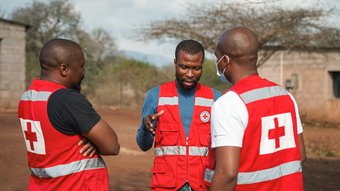
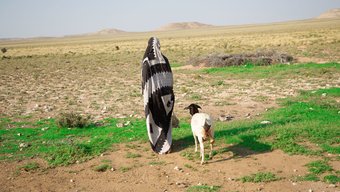
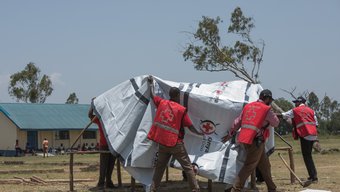
Over 70 photos were submitted to the contest, held under the title 'Stories of resilience: a decade of anticipatory action in focus', with the high quality and huge diversity across the entries making the decision-making process challenging. Eventually, the judges awarded first prize to Alexis Vallajo, Food and Agriculture Organization of the United Nations (FAO), for his photo from Bolivia. Second prize went to Hassan Haji Ibrahim, Gargaar Relief and Development Organization (GREDO), for his photo from Somalia, and third place to Ei Hnin Hlaing, FAO, with a photo from Mongolia.
The top three entries in the photo contest

Installing reservoirs to anticipate drought in the Altiplano, Bolivia. These are essential for storing water in the highlands. Alexis Vallejo, FAO, 2024.

Under the shade of a tree in a dry landscape in Somalia, local community leaders gather to discuss early warning signs, risk mapping, and collective anticipatory strategies. Hassan Haji Ibrahim, GREDO, 2024.

Anticipatory action brings life: showing off newborn lambs, thanks to the FAO's anticipatory action interventions in Burd Soum, Mongolia. Ei Hnin Hlaing, FAO, 2018.
Installing reservoirs to anticipate drought in the Altiplano, Bolivia. These are essential for storing water in the highlands. Alexis Vallejo, FAO, 2024.
Under the shade of a tree in a dry landscape in Somalia, local community leaders gather to discuss early warning signs, risk mapping, and collective anticipatory strategies. Hassan Haji Ibrahim, GREDO, 2024.
Anticipatory action brings life: showing off newborn lambs, thanks to the FAO's anticipatory action interventions in Burd Soum, Mongolia. Ei Hnin Hlaing, FAO, 2018.
The photo contest was part of activities to celebrate the first decade of anticipatory action. Many of the earlier sessions looked ahead, though, with thought-provoking discussions about the next ten years. How can anticipatory action continue to save lives at a time when humanitarian funding is being squeezed? How can we gather more evidence of its impacts, and make better use of the wealth of evidence already obtained?
Such questions cannot be resolved in one day, and the discussions will continue into 2026: through the Anticipation Hub and at upcoming events and forums. Yet one message came through clearly throughout the 13th Global Dialogue Platform: there is a fierce commitment to build on the successes already gained. "This event is very important," noted Habimana Jonas Seruvugo via the event website chat, "and gives me other ideas on how to redesign our strategies in the Democratic Republic of the Congo."
Shortlisted finalists in the photography competition

For Sergio and his Honduran family, implementing new techniques has made a significant difference to their harvest. "Before, we planted without following any particular technique, but now, with the furrows and the support we received, the plants are growing well. Now we're going to have corn at home, which we didn't have before.” Alexis Vallejo, FAO, 2024.

In Ulipur, Bangladesh, Maidul Islam stands as a frontline guardian of flood preparedness. He reads the newly installed river gauge five times daily and sends water-level data via SMS twice a day. This gauge, installed after community consultations, provides vital localized data that helps the community act ahead of floods. Utkalita Rahman, CARE, 2023.

Community members receive drought-resistant seeds and learn agricultural techniques to enhance resilience to climate shocks during a farmers' field school in Manalobe, Western Southern Madagascar. Gabriela Vivacqua, WFP, 2024.

Local wisdom can build anticipatory action. This photo captures a workshop to develop an anticipatory action plan, which brought together a wide range of stakeholders. During the workshop, representatives from the meteorological office presented their forecast products, while traditional seers demonstrated their indigenous forecasting methods by reading animal intestines and sharing their knowledge with participants. Jessica Kühnle, Welthungerhilfe, 2025.

Preparing farmland in Berdaley village as part of anticipatory actions in the Somali Region of Ethiopia, after the enclosure of rangelands. WFP, 2024.

Indigenous women from Chocó, Colombia, dry plantains in a community facility to extend the shelf life of perishable foods. Plantains are used to prepare various dishes and this action helps families protect themselves against food shortages caused by extreme events. Oliver Molano, FAO, 2025.

Thanks to the implementation of cash-for-work activities, participants rehabilitated and built dykes to protect cultivated areas from floods. This picture shows a critical section of the dyke reinforced with gabions in 2023 at Tarna, Nigeria. FAO.

"The suffering was intense. The moment the water from Goulbi arrived, it would wipe out all the fields, annihilating all our farming efforts. This situation plunged us into chaos, in which most families did not have enough to eat. The fields that survived the waters were not enough to feed us all. We can only thank this project and wish for even more." Oumarou participated in an activation for floods in Niger; this photo shows him in his maize field in Djirataoua. FAO, 2024.

Local farmers in the Koshi Basin, Nepal, prepare for potential flooding by storing harvested grain in hermetic storage bags. This air-tight technology helps prevent post-harvest losses due to pests, mould and moisture. Stine Heiselberg, FAO, 2024.

Ahead of severe floods in Nepal, the United Nations Population Fund established two women-friendly spaces for gender-based-violence-prevention and -response services, and for sexual and reproductive health awareness, through the mobilization of female community-health volunteers. Stine Heiselberg, FAO, 2024.

Gafod Sherif Hussen, from Shahid village, Somali Region, Ethiopia, receives financial assistance as part of WFP's anticipatory action programme, which aims to enhance people's safety and preparedness. Michael Tewelde, WFP, 2024.

Jummai Joel and her daughter Elizabeth, traders from Beti Town in Fufore, live close to the riverbank and face recurring floods, especially during heavy rains or when water is released from Cameroon into the Benue River. Each year, Jummai is forced to relocate to a nearby town for safety. She hadn’t anticipated any support until WFP’s targeting and verification process identified her household for assistance. With the cash she received, Jummai built a protective fence that helped prevent floodwaters from entering her home during the recent rains. She also used part of the funds to provide food for her family and invest in her small business. Oluwashina Oni, WFP, 2025.
For Sergio and his Honduran family, implementing new techniques has made a significant difference to their harvest. "Before, we planted without following any particular technique, but now, with the furrows and the support we received, the plants are growing well. Now we're going to have corn at home, which we didn't have before.” Alexis Vallejo, FAO, 2024.
In Ulipur, Bangladesh, Maidul Islam stands as a frontline guardian of flood preparedness. He reads the newly installed river gauge five times daily and sends water-level data via SMS twice a day. This gauge, installed after community consultations, provides vital localized data that helps the community act ahead of floods. Utkalita Rahman, CARE, 2023.
Community members receive drought-resistant seeds and learn agricultural techniques to enhance resilience to climate shocks during a farmers' field school in Manalobe, Western Southern Madagascar. Gabriela Vivacqua, WFP, 2024.
Local wisdom can build anticipatory action. This photo captures a workshop to develop an anticipatory action plan, which brought together a wide range of stakeholders. During the workshop, representatives from the meteorological office presented their forecast products, while traditional seers demonstrated their indigenous forecasting methods by reading animal intestines and sharing their knowledge with participants. Jessica Kühnle, Welthungerhilfe, 2025.
Preparing farmland in Berdaley village as part of anticipatory actions in the Somali Region of Ethiopia, after the enclosure of rangelands. WFP, 2024.
Indigenous women from Chocó, Colombia, dry plantains in a community facility to extend the shelf life of perishable foods. Plantains are used to prepare various dishes and this action helps families protect themselves against food shortages caused by extreme events. Oliver Molano, FAO, 2025.
Thanks to the implementation of cash-for-work activities, participants rehabilitated and built dykes to protect cultivated areas from floods. This picture shows a critical section of the dyke reinforced with gabions in 2023 at Tarna, Nigeria. FAO.
"The suffering was intense. The moment the water from Goulbi arrived, it would wipe out all the fields, annihilating all our farming efforts. This situation plunged us into chaos, in which most families did not have enough to eat. The fields that survived the waters were not enough to feed us all. We can only thank this project and wish for even more." Oumarou participated in an activation for floods in Niger; this photo shows him in his maize field in Djirataoua. FAO, 2024.
Local farmers in the Koshi Basin, Nepal, prepare for potential flooding by storing harvested grain in hermetic storage bags. This air-tight technology helps prevent post-harvest losses due to pests, mould and moisture. Stine Heiselberg, FAO, 2024.
Ahead of severe floods in Nepal, the United Nations Population Fund established two women-friendly spaces for gender-based-violence-prevention and -response services, and for sexual and reproductive health awareness, through the mobilization of female community-health volunteers. Stine Heiselberg, FAO, 2024.
Gafod Sherif Hussen, from Shahid village, Somali Region, Ethiopia, receives financial assistance as part of WFP's anticipatory action programme, which aims to enhance people's safety and preparedness. Michael Tewelde, WFP, 2024.
Jummai Joel and her daughter Elizabeth, traders from Beti Town in Fufore, live close to the riverbank and face recurring floods, especially during heavy rains or when water is released from Cameroon into the Benue River. Each year, Jummai is forced to relocate to a nearby town for safety. She hadn’t anticipated any support until WFP’s targeting and verification process identified her household for assistance. With the cash she received, Jummai built a protective fence that helped prevent floodwaters from entering her home during the recent rains. She also used part of the funds to provide food for her family and invest in her small business. Oluwashina Oni, WFP, 2025.
The 13th Global Dialogue Platform was hosted by the Anticipation Hub, an initiative of the International Federation of Red Cross and Red Crescent Societies, the German Red Cross and the Red Cross Red Crescent Climate Centre, and co-organized by the Danish Refugee Council, FAO, GREDO, the United Nations Office for the Coordination of Humanitarian Affairs, Start Network, Welthungerhilfe and the World Food Programme. It was supported by the German Federal Foreign Office.