
- Asia
- Bangladesh
 Flash flood

Protocols and Trigger-based Institutional Systems for Timely Humanitarian & Anticipatory Action (PROTISTHAA)
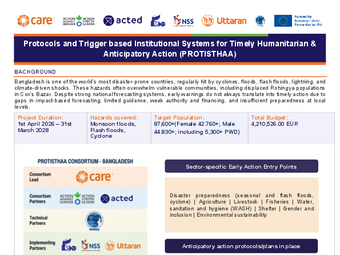
The PROTISTHAA project strengthens anticipatory action systems in Bangladesh and ensures that forecasts lead to timely action before disasters occur. It targets vulnerable populations in flood-prone northern districts, flash flood-prone haor areas in the north-east, cyclone-prone coastal districts in the south-west, and Rohingya refugees living in the 33 camps of Cox's Bazar.
Protocols and Trigger-based Institutional Systems for Timely Humanitarian & Anticipatory Action (PROTISTHAA)
Bangladesh is one of the world's most disaster-prone countries, regularly affected by monsoon floods, flash floods, cyclones, storm surges, landslides, fires and other climate-related hazards. Climate change is increasing the frequency and severity of these events, placing growing pressure on vulnerable communities whose livelihoods depend on agriculture, fisheries, livestock and other climate-sensitive sectors.
The PROTISTHAA project (Protocols and Trigger-based Institutional Systems for Timely Humanitarian & Anticipatory Action) was established to strengthen anticipatory action systems in Bangladesh and ensure that forecasts lead to timely action before disasters occur. The project targets vulnerable populations in flood-prone northern districts, flash flood-prone haor areas in the north-east, cyclone-prone coastal districts in the south-west, and Rohingya refugees living in the 33 camps of Cox's Bazar.
Funded by the European Civil Protection and Humanitarian Aid Operations (DG ECHO), PROTISTHAA seeks to reduce the loss of life and livelihoods, and reduce humanitarian needs by improving the link between forecasts, decision-making, financing and early action. By strengthening both institutional systems and community preparedness, it aims to enhance resilience and support a shift from reactive disaster response towards proactive and risk-informed humanitarian action across Bangladesh.
Key facts
Start/end date
1 April 2026 to 31 March 2028
Hazards covered
- Cyclones
- Fires
- Flash floods
- Landslides
- Monsoon floods
- Storm surges
- Other climate-related hazards and shocks
Regions covered
- Northern Bangladesh
- North-eastern Bangladesh (Haor Region)
- South-Western Coastal Bangladesh
- Cox's Bazar (Rohingya camps)
Budget
4,210,526 euros
About the project
PROTISTHAA is a consortium project implemented from April 2026 to March 2028 by CARE, ACTED, Action Against Hunger (ACF) and the Regional Integrated Multi-Hazard Early Warning System (RIMES), in partnership with local organizations ESDO, Uttaran and NSS.
The project is built on the recognition that Bangladesh already possesses strong forecasting capacities, but that forecasts do not always translate into timely action. Gaps in institutional coordination, disaster financing, preparedness systems and last-mile risk communication often prevent vulnerable populations from fully benefitting from available early-warning information.
PROTISTHAA addresses these challenges by strengthening the entire forecast-to-action chain and embedding anticipatory action within national and local disaster-management systems.
The project pursues four interconnected objectives:
- Enhance multi-hazard forecasting and impact-based early warning systems to provide actionable information for government agencies, humanitarian actors, and at-risk communities.
- Strengthen government capacity and institutional systems through improved protocols, coordination mechanisms, and disaster risk financing arrangements that support anticipatory action.
- Improve community preparedness and response capacities through volunteer networks, inclusive preparedness planning, early warning dissemination, and community-based disaster risk management.
- Provide flexible emergency assistancethrough a crisis modifier mechanism to support affected populations when major disasters exceed anticipatory action capacities.
By linking forecasting, triggers, financing and action, PROTISTHAA aims to institutionalize anticipatory action in Bangladesh, improve coordination among key stakeholders, and enable vulnerable communities to take timely measures that protect lives, livelihoods and assets before disasters strike.
To operationalize this vision, the PROTISTHAA consortium launched its official journey and established foundational operational frameworks through dedicated Detailed Implementation Plan (DIP) and MEAL workshops. In parallel:
- ESDO completed project inception meetings across district, upazila and union levels, alongside training field facilitators and volunteers
- NSS and Uttaran are actively conducting field-level inceptions in their respective coverage areas.
Grounded in community realities, joint field visits with DG ECHO to flood-prone Sunamganj and Gaibandha highlighted acute gender-specific vulnerabilities in WASH, maternal healthcare and resilient infrastructure, underscoring the urgent need for formalized local multi-hazard triggers, structural budget lines, dual-channel warning protocols, and pre-disaster protective public works.
Building institutional visibility and national alignment, the project showcased its core functionality during a visit by the Honorable Minister of Disaster Management and Relief to Kurigram. Furthermore, PROTISTHAA successfully observed the International Day for Disaster Risk Reduction in 2026, across both national and sub-national platforms, to amplify public awareness.
Contacts
Implementing organizations

CARE
Learn more
Action Against Hunger
Learn more
ACTED
Learn more
RIMES
Learn more
ESDO
Learn more
Uttaran
Learn more
NSS
Learn moreFunder

DG ECHO
Learn morePhoto: Female community members in Gaibandha District share their insights and disaster preparedness needs with the team and DG ECHO during their visit in July 2026. © Fuad Ur Rabbi/CARE Bangladesh