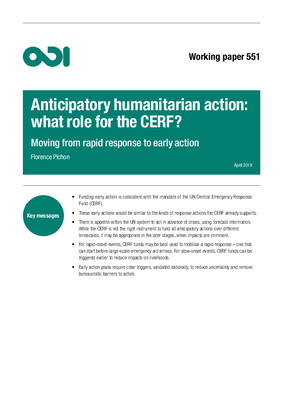
Anticipatory humanitarian action: what role for the CERF? Moving from rapid response to early action
Funding early action is consistent with the mandate of the UN Central Emergency Response Fund (CERF). These early actions would be similar to the kinds of response actions the CERF already supports. There is appetite within the UN system to act in advance of crises, using forecast information. While the CERF is not the right instrument to fund all anticipatory actions over different timescales, it may be appropriate in the later stages, when impacts are imminent. For rapid-onset events, CERF funds may be best used to mobilise a rapid response – one that can start before large-scale emergency aid arrives. For slow-onset events, CERF funds can be triggered earlier to reduce impacts on livelihoods. Early action plans require clear triggers, validated nationally, to reduce uncertainty and remove bureaucratic barriers to action
Resource Type
PDF, 370.32 KB
Year
2019
Content Type
Report
Thematic Area
Disaster Risk Financing, Activation, Lessons Learnt
Organization type
Academic & Research Institutions
Hazard
Cyclone / hurricane / tropical storm / typhoon, Drought / dry spell, Heavy rain, Flood

 Drought / dry spell