
Anticipatory Action in Humanitarian Settings
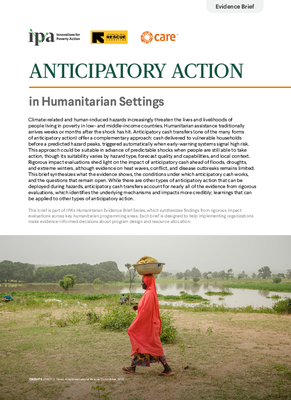
Climate-related and human-induced hazards increasingly threaten the lives and livelihoods of people living in poverty in low- and middle-income countries. Humanitarian assistance traditionally arrives weeks or months after the shock has hit. Anticipatory cash transfers (one of the many forms of anticipatory action) offer a complementary approach: cash delivered to vulnerable households before a predicted hazard peaks, triggered automatically when early-warning systems signal high risk. This approach could be suitable in advance of predictable shocks when people are still able to take action, though its suitability varies by hazard type, forecast quality and capabilities, and local context. Rigorous impact evaluations shed light on the impact of anticipatory cash ahead of floods, droughts, and extreme winters, although evidence on heat waves, conflict, and disease outbreaks remains limited.
This brief synthesizes what the evidence shows, the conditions under which anticipatory cash works, and the questions that remain open. While there are other types of anticipatory action that can be deployed during hazards, anticipatory cash transfers account for nearly all of the evidence from rigorous evaluations, which identifies the underlying mechanisms and impacts more credibly; learnings that can be applied to other types of anticipatory action.
This briefing was originally published on the Innovation for Poverty Action website.
Publish Date
September 30, 2026
Resource Type
PDF, 3.15 MB
Authors
IPA, IRC and CARE
Year
2026
Country
Bangladesh, Kenya, Mongolia
Content Type
Briefing sheet / factsheet
Thematic Area
Cash and Voucher

 Drought / dry spell
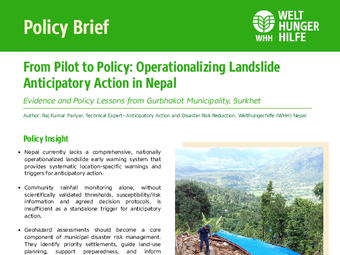
 Landslide / mudslide